Premium handmade carpets are far more than decorative flooring products. They represent centuries of craftsmanship, cultural heritage, artistic expression, and human dedication woven into every single thread. Across the world, luxury handmade carpets are admired not only for their beauty and durability but also for the extraordinary effort involved in their creation. In an era dominated by automation and machine production, handmade carpets continue to hold unmatched value because every piece reflects the skill, patience, and creativity of master artisans.
The global demand for Premium Handmade Carpets continues growing in 2026 as luxury homeowners, interior designers, hotels, collectors, and architects increasingly seek authentic handcrafted products that offer exclusivity and timeless elegance. Unlike machine-made carpets, handmade rugs carry individuality. No two handmade carpets are ever completely identical, which is one of the reasons they are considered luxury art pieces rather than ordinary flooring materials.
The manufacturing process of a premium handmade carpet is highly detailed and labor-intensive. Depending on the complexity of the design, material quality, knot density, and carpet size, the production process may take several weeks, months, or even years. Every stage requires precision and craftsmanship to ensure the final product meets international luxury standards.
The journey of a handmade carpet begins with design conceptualization. Designers and artisans first create intricate carpet patterns inspired by cultural heritage, architecture, nature, floral art, geometric themes, or modern interior trends. Traditional Persian, Turkish, Kashmiri, and Indian carpet designs often contain symbolic artistic elements passed down through generations.
In modern luxury carpet manufacturing, designers increasingly blend traditional motifs with contemporary aesthetics to suit evolving interior design preferences. Some premium carpets are custom-designed specifically for luxury villas, hotels, royal residences, and designer interiors. These bespoke carpet designs allow complete personalization in terms of color palettes, textures, patterns, and dimensions.
After finalizing the design, the next crucial step involves selecting raw materials. Material quality directly influences the softness, durability, appearance, and overall luxury feel of the carpet. Premium handmade carpets are typically crafted using high-quality wool, silk, cotton, or combinations of natural fibers.
Wool remains one of the most preferred materials because of its strength, softness, resilience, and natural ability to retain color. Silk is often used in luxury carpets to create a refined sheen and intricate detailing. Cotton is commonly used for the carpet foundation because it provides structural stability and flexibility.
The selection of fibers is carefully monitored because luxury carpet buyers expect exceptional quality and long-lasting durability. In premium carpet manufacturing, even the texture and thickness of the fibers are analyzed before production begins.
Once the raw materials are selected, the yarn preparation process starts. Wool or silk fibers are cleaned thoroughly to remove impurities, dust, and natural oils. The fibers are then spun into yarn using traditional spinning methods or specialized spinning equipment.
The quality of yarn spinning significantly impacts the carpet’s final texture and strength. Uniform yarn thickness ensures consistent knotting and weaving throughout the carpet. Skilled craftsmen pay close attention to maintaining balanced fiber tension during spinning to achieve superior finishing quality.
Dyeing is one of the most artistic stages in the Handmade Carpet Manufacturing Process. Colors play a major role in defining the visual appeal and emotional impact of a carpet. Premium carpet manufacturers often use natural dyes extracted from plants, flowers, roots, minerals, and organic substances to create rich and long-lasting shades.
Natural dyeing techniques have been practiced for centuries in traditional carpet-producing regions such as India, Iran, Turkey, and Central Asia. These dyes produce unique color depth and subtle tonal variations that enhance the artistic beauty of handmade carpets.
Modern luxury carpet manufacturers may also use advanced eco-friendly dyeing technologies to achieve highly customized color palettes while maintaining environmental sustainability. Dye consistency is carefully controlled because uneven coloring can reduce the overall value of a premium handmade rug.
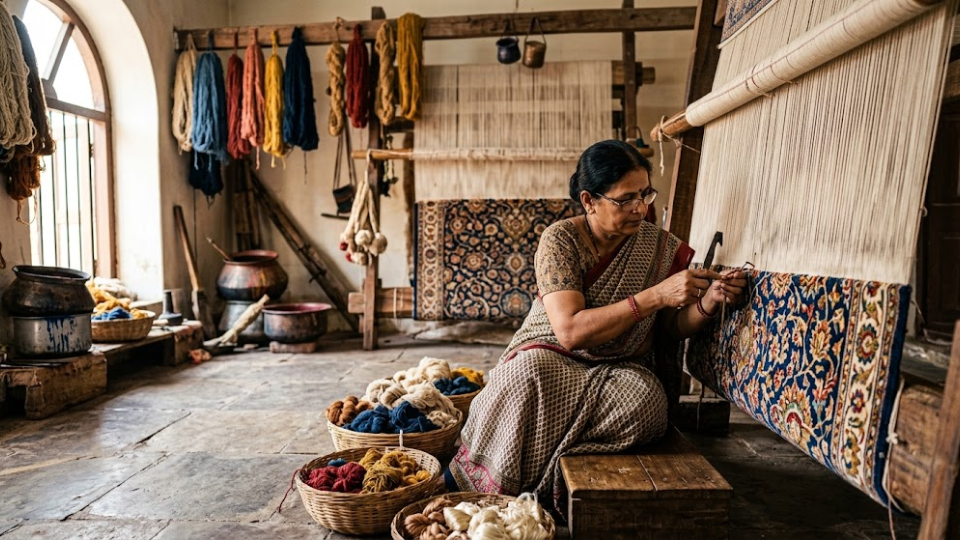
After dyeing, the weaving process begins, which is considered the heart of handmade carpet production. Skilled artisans work on vertical or horizontal looms where thousands or even millions of knots are tied individually by hand.
Hand-knotting is an incredibly time-consuming and specialized skill that requires years of training and experience. Each knot is tied manually according to the carpet design map, also known as a blueprint or graph. Knot density determines the detail and quality of the carpet. High-density carpets contain more knots per square inch, allowing finer patterns and superior craftsmanship.
Luxury handmade carpets often contain extremely high knot counts, which significantly increase production time and artistic value. Some master artisans spend entire days weaving only a few inches of carpet because precision is essential for maintaining design accuracy.
The weaving process requires exceptional concentration and coordination among artisans. In many traditional carpet workshops, weaving knowledge is passed down through generations, preserving cultural craftsmanship and heritage techniques.
As weaving progresses, artisans continuously inspect the carpet for alignment, symmetry, and knot consistency. Minor irregularities are corrected immediately because even small imperfections can affect the carpet’s final appearance and quality.
Once the knotting process is completed, the carpet is carefully removed from the loom and enters the finishing stage. This stage involves multiple processes designed to refine the carpet’s texture, softness, and visual clarity.
The carpet is first trimmed using specialized cutting tools to create an even pile height. Skilled finishers sculpt certain design elements to enhance depth and artistic detailing. This carving process adds dimension and luxury texture to premium carpets.
Washing is another essential step in the manufacturing process. Handmade carpets are thoroughly washed to remove excess dye, dust, and loose fibers. Traditional washing methods often involve natural soaps and flowing water systems that soften the carpet fibers and enhance color richness.
After washing, the carpet is stretched and dried carefully to maintain its shape and structural balance. Drying conditions are monitored closely because uneven drying can distort the carpet’s dimensions.
The final finishing process includes quality inspection, edge binding, surface polishing, and detailed craftsmanship review. Master inspectors evaluate every carpet for weaving precision, color consistency, texture quality, and finishing perfection before approving it for sale or export.
In luxury carpet manufacturing, quality control standards are extremely strict because premium buyers expect flawless artistry and long-term durability. Handmade carpets are often treated as investment pieces that can last for generations when maintained properly.
One of the most remarkable aspects of premium handmade carpet manufacturing is the human connection involved in every stage. Unlike mass-produced carpets created by automated machinery, handmade rugs carry the personal touch of artisans whose skills and dedication become permanently embedded within the product.
This emotional and artistic value is one of the primary reasons why luxury handmade carpets remain highly respected in the global interior design and luxury décor industry. Interior designers, collectors, architects, and luxury homeowners appreciate handmade carpets not only for their visual elegance but also for the heritage and craftsmanship they represent.
In 2026, the demand for authentic handmade carpets continues growing because modern consumers increasingly value artisanal products, sustainability, and uniqueness. Luxury buyers are moving away from generic machine-made interiors and investing in handcrafted décor elements that reflect culture, artistry, and individuality.
The global handmade carpet industry also supports thousands of artisan communities worldwide. In countries such as India, Iran, Nepal, Turkey, and Afghanistan, carpet weaving provides employment, preserves traditional skills, and sustains cultural heritage across generations.
Modern technology is now helping premium handmade carpet manufacturers expand globally through digital marketing, e-commerce platforms, virtual design tools, and international export networks. Buyers can explore custom carpet collections online and collaborate directly with manufacturers for bespoke luxury projects.
Despite technological advancements, the essence of premium handmade carpet manufacturing remains deeply rooted in patience, craftsmanship, and human artistry. Every finished carpet tells a story of dedication, culture, and timeless elegance woven carefully by skilled hands.
The future of the Premium Handmade Carpet Industry looks exceptionally promising as luxury interior design trends continue emphasizing authenticity, sustainability, personalization, and artisanal craftsmanship. Handmade carpets will continue serving not only as functional flooring products but also as artistic masterpieces that bring warmth, beauty, and heritage into modern spaces.
For manufacturers, exporters, interior designers, and luxury décor brands, understanding the craftsmanship behind handmade carpets is essential for appreciating their true value. Behind every premium handmade carpet lies a remarkable journey of creativity, tradition, and extraordinary human skill that transforms simple fibers into timeless works of art.