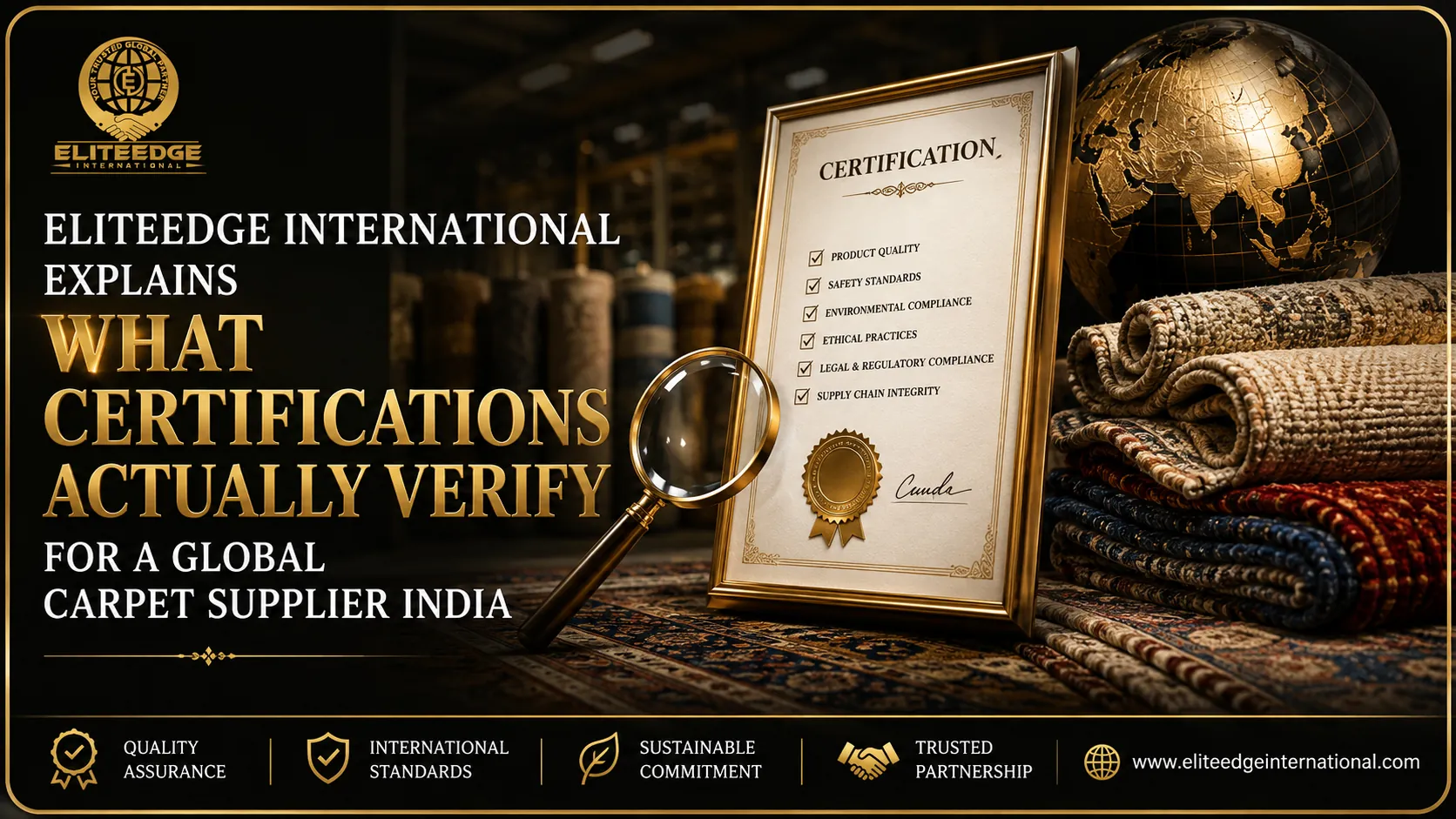
Certification logos scattered across a supplier’s website carry an air of authority that buyers rarely question closely, yet these marks vary enormously in what they actually verify, who issues them, and how rigorously they are actually enforced in practice across different industries and regions. Buyers evaluating a global carpet supplier India relationship deserve a clear explanation of what common certifications genuinely confirm, rather than treating every logo as interchangeable proof of quality or responsibility. Eliteedge International, based in Jalgaon, Maharashtra, believes buyers make better decisions when they understand certification systems clearly enough to ask informed follow up questions rather than accepting a badge at face value without further scrutiny.
This article walks through the most common certifications buyers encounter when evaluating a sustainable carpet exporters India relationship, explaining what each one actually verifies, its limitations, and how buyers should incorporate certification claims into a broader, more complete supplier evaluation.
Why Certifications Deserve Closer Reading Than a Passing Glance
Not All Certifications Carry Equal Rigour
Some certifications involve genuinely rigorous third party auditing conducted by an independent organisation with no financial relationship to the certified business, while others amount to little more than a self declared claim with minimal or no independent verification behind it. Buyers should ask specifically who issued a certification, whether that issuing body is independent of the supplier, and what specific auditing process was actually involved before assuming a particular badge carries meaningful weight.
Certifications Often Cover a Narrower Scope Than Buyers Assume
A specific certification frequently verifies one narrow aspect of a business or product, such as a particular safety standard or a specific stage of the manufacturing process, rather than confirming broad, general quality or responsibility across an entire operation. Buyers should understand precisely what a specific certification actually covers rather than assuming it confirms a broader set of positive attributes beyond its genuine, documented scope.
Common Certifications Relevant to Carpet and Mat Manufacturing
ISO Quality Management Standards
International Organization for Standardization certifications, most commonly ISO 9001 for quality management systems, verify that a business follows documented, consistent processes for managing quality throughout its operations. This certification confirms process discipline rather than confirming any specific product attribute directly, meaning a certified business has demonstrated it follows a consistent quality management system, though the certification itself does not guarantee any particular product will be defect free.
OEKO TEX and Textile Safety Certifications
Certifications specifically addressing textile safety, verifying that a product has been tested for harmful substances and meets specific safety thresholds relevant to textile products, offer buyers meaningful assurance about a specific, well defined safety dimension. Buyers should confirm which specific product line a textile safety certification actually applies to, since a certification obtained for one specific product does not automatically extend to every other item in a supplier’s broader catalogue.
GST and Export Registration Documentation
While not technically a certification in the traditional sense, valid GST registration and export documentation represent baseline legal compliance that buyers should verify independently through official government channels rather than relying purely on a supplier’s own claim of compliance. This verification confirms legal business standing rather than product quality specifically, but it remains an essential foundation for any legitimate international trade relationship.
Industry Association Membership
Membership in recognised trade or export promotion associations, such as those supporting Indian handicraft exporters, can indicate a business’s engagement with broader industry standards and networks, though membership criteria vary by association and generally represent a lower bar than a rigorous, independently audited certification process.
Evaluating Certification Claims for Custom or Private Label Orders
Certification Scope for Customised Products
Buyers pursuing significant customisation, such as private label branding or unique colour combinations, should confirm whether existing certifications for a supplier’s standard catalogue items automatically extend to the customised version of that product, or whether customisation potentially affects certification validity in ways that require separate verification. This distinction matters particularly for safety related certifications where material substitutions or construction changes could genuinely affect the underlying compliance basis for the original certification.
Requesting Certification Updates for New Product Development
When developing an entirely new private label product line with a supplier, buyers interested in specific certifications should raise this requirement early in the product development conversation, since obtaining a new or updated certification for a genuinely new product can add meaningful time to an already lengthy development timeline, and this consideration should be factored into overall project planning from the outset rather than discovered as a surprise delay much later in the process.
Understanding the Broader Certification Landscape Buyers May Encounter
Regional Versus Internationally Recognised Certifications
Some certifications carry recognition primarily within a specific region or country, while others enjoy broad international recognition across most major markets. Buyers should understand which category a specific certification falls into, since a certification well recognised in one market may carry little practical weight or awareness among customers in a different destination market, affecting how useful that certification actually is for the buyer’s specific marketing purposes.
Certifications Focused on Labour and Working Conditions
Beyond product safety and quality management, some certifications specifically address labour practices and working conditions within a manufacturing facility, verifying fair wages, reasonable working hours, and safe working environments for production staff. Buyers particularly concerned with the social responsibility dimension of their supply chain should ask specifically about this category of certification, since it addresses a genuinely different concern than product safety or quality management certifications discussed elsewhere in this guide.
Emerging Certifications Specific to Circular Economy Practices
As circular economy and recycled content conversations gain more attention across the broader manufacturing industry, new certification frameworks specifically verifying recycled content percentages and material traceability continue to emerge and evolve. Buyers interested in this specific dimension should ask suppliers directly whether they participate in any of these emerging frameworks, recognising that this certification landscape remains considerably less standardised and mature than longer established quality and safety certification systems.
Why Some Legitimate Suppliers Choose Not to Pursue Formal Certification
The Cost and Administrative Burden of Certification
Pursuing and maintaining formal certification involves genuine cost, both in direct fees paid to certification bodies and in the internal administrative resources needed to prepare for and pass an audit successfully. Smaller or newer businesses sometimes reasonably choose to invest their limited resources elsewhere, particularly if their existing buyer base has not specifically demanded formal certification as a condition of doing business together.
Certification Relevance Varies by Target Market
A supplier whose buyer base is concentrated in markets where formal certification carries less commercial importance may reasonably prioritise other investments over certification pursuit, while a supplier actively targeting markets where buyers consistently require specific certifications will naturally prioritise obtaining those certifications to remain competitive within that particular market segment.
How Buyers Should Weigh the Absence of Certification
The absence of a specific certification should prompt buyers to ask more direct, specific questions and rely more heavily on other due diligence methods such as sampling and business verification, rather than automatically disqualifying an otherwise promising supplier. A thoughtful conversation about why a particular certification has not been pursued, and whether the underlying practices that certification would verify are nonetheless genuinely in place, often reveals more useful information than the simple presence or absence of a logo on a website.
What Certifications Cannot Tell You
Current, Ongoing Compliance
A certification obtained at a specific point in time does not automatically guarantee ongoing compliance with the same standard indefinitely, particularly for certifications that do not require regular re auditing. Buyers should ask when a specific certification was last verified or renewed, rather than assuming a certification obtained several years ago necessarily reflects current practices at the business today.
Consistency Across an Entire Product Range
A certification obtained for one specific product or production line does not automatically extend to every other item in a supplier’s broader catalogue, particularly for a business like Eliteedge International producing both machine manufactured polypropylene mats and hand tufted carpets through genuinely different production processes that may carry different certification relevance.
Everything Buyers Genuinely Care About
Certifications typically address specific, narrow dimensions such as safety, quality management process, or environmental compliance in a particular area, but they cannot substitute for the broader due diligence process covering business verification, communication quality, and direct product evaluation discussed throughout this ongoing series of guidance for international buyers. Certifications are one useful input into a broader evaluation, not a substitute for that evaluation entirely on their own.
How Buyers Should Incorporate Certifications Into Their Evaluation
Asking for Specific Certificate Documentation
Rather than accepting a certification logo displayed on a website at face value, buyers should request the actual certificate documentation, including the specific issuing body, the scope of what was certified, and the certification’s current validity status, treating this request as a standard, reasonable part of supplier due diligence.
Verifying Certifications Independently Where Possible
For certifications issued by well known, established bodies, buyers can often verify a specific certificate’s validity directly through the issuing organisation’s own records, rather than relying solely on the supplier’s presentation of the certificate, providing an additional layer of confidence beyond simply trusting the supplier’s own claim.
Treating Certifications as One Input Among Several
Buyers should weigh certification claims alongside the other evaluation criteria discussed throughout this series, including business verification, direct product sampling, and communication quality, rather than treating a certification as a standalone substitute for this broader evaluation process that a significant sourcing decision genuinely deserves.
Discussing Certifications With Eliteedge International
Buyers evaluating Eliteedge International as a global carpet supplier India relationship can ask directly about any relevant certifications applicable to specific product lines under consideration, requesting documentation and clarity on exactly what scope each certification actually covers before incorporating that information into a broader evaluation.
Buyers interested in the sustainable carpet exporters India conversation specifically should apply this same careful, specific questioning approach discussed throughout this guide, distinguishing between genuine, well substantiated certifications and looser, self declared claims that carry considerably less independent verification behind them.
Conclusion
Certification logos deserve closer reading than a passing glance, since they vary considerably in rigour, scope, and ongoing validity. Understanding what a specific certification actually verifies, who issued it, and what scope it genuinely covers helps buyers evaluating a global carpet supplier India relationship incorporate certification claims meaningfully into a broader evaluation, rather than treating any badge as automatic proof of quality or responsibility across an entire business and product range.
If your business wants a clear, honest conversation about certifications relevant to your specific sourcing needs, reach out to Eliteedge International to discuss which certifications apply to which specific products.
Frequently Asked Questions
1. Does ISO 9001 certification guarantee defect free products?
No, ISO 9001 verifies that a business follows a documented, consistent quality management process, but it does not guarantee any specific product will be entirely defect free. It confirms process discipline rather than a specific product outcome guarantee.
2. How can buyers verify a certification is genuine and current?
Buyers can request the actual certificate documentation, including issuing body and validity dates, and for well known certification bodies, often verify the certificate’s validity directly through the issuing organisation’s own records rather than relying solely on the supplier’s presentation.
3. Does a certification for one product apply to a supplier’s entire catalogue?
Not necessarily. A certification obtained for one specific product or production line does not automatically extend to every other item in a broader catalogue, particularly when different products involve genuinely different production processes.
4. What is the difference between a rigorous certification and a self declared claim?
A rigorous certification involves independent third party auditing by an issuing body with no financial relationship to the certified business, while a self declared claim involves no independent verification, relying purely on the business’s own assertion without external confirmation.
5. Should buyers avoid suppliers without any formal certifications?
Not necessarily. A lack of formal certification does not automatically indicate poor quality, particularly for smaller or newer businesses, though buyers should apply other due diligence methods such as direct sampling and business verification more thoroughly in the absence of formal certification.
6. How often should buyers check whether a certification is still valid?
Certifications requiring periodic re auditing should be checked against their current renewal status, particularly for longer term supplier relationships, since a certification obtained several years ago may not necessarily reflect current practices without confirmed ongoing renewal.
7. Can buyers request to see certification documentation directly?
Yes, requesting actual certificate documentation, rather than relying solely on a logo displayed on a website, is a standard and reasonable part of supplier due diligence that any legitimate business holding genuine certifications should be able to accommodate without hesitation.
8. Do certifications replace the need for physical product sampling?
No, certifications address specific, narrow dimensions and should be treated as one input among several in a broader evaluation process, not a substitute for direct product sampling, business verification, and the other due diligence steps a significant sourcing decision genuinely deserves.