
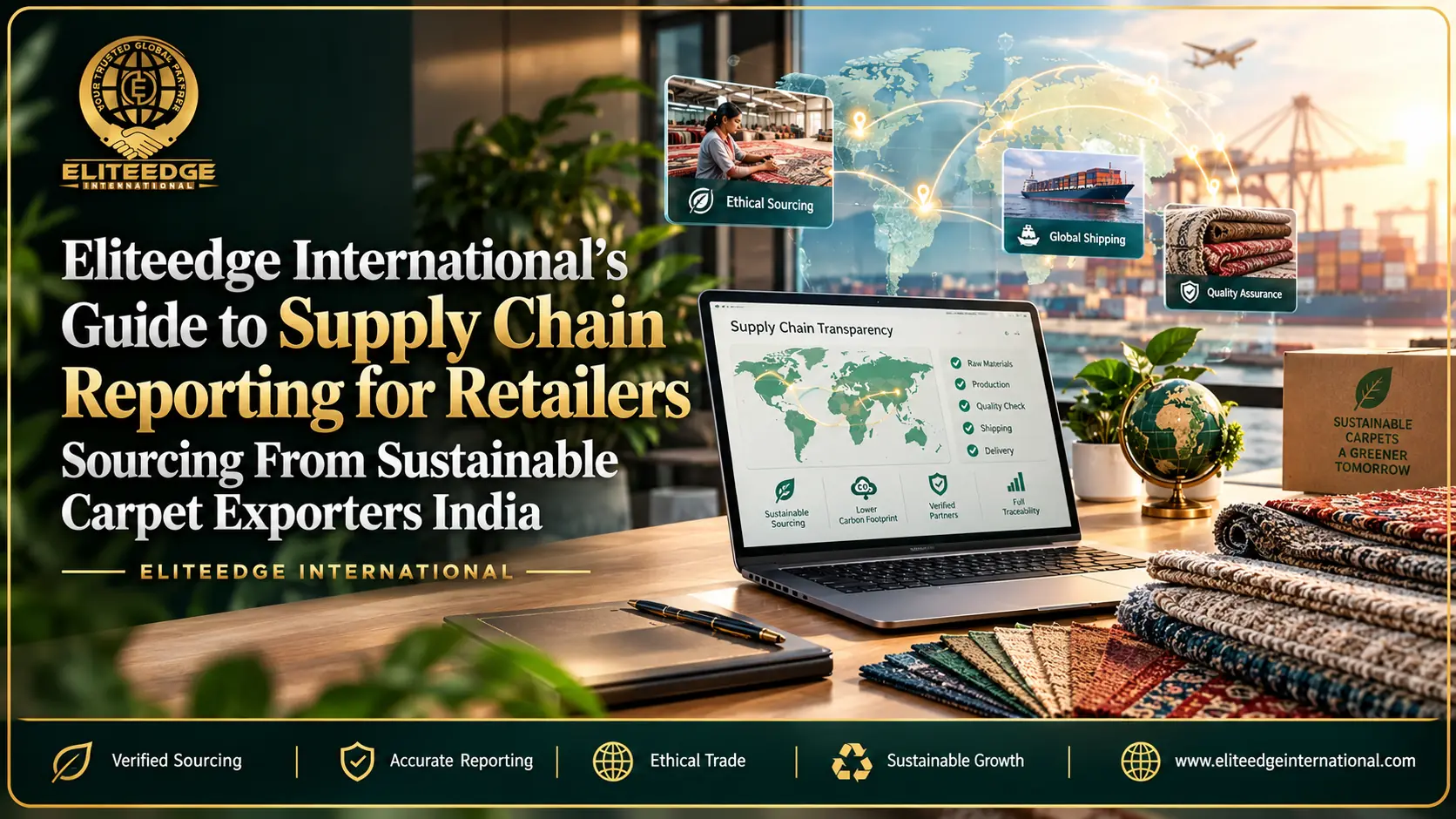
Retailers increasingly face questions from their own stakeholders, whether investors, corporate customers, or simply curious end consumers, about where their products actually come from and what specifically their supplier relationships involve on a day to day basis. Buyers sourcing from a sustainable carpet exporters India relationship benefit from understanding what genuine supply chain reporting actually requires, distinct from the marketing and certification conversations covered elsewhere in this guidance series, since reporting to internal or external stakeholders demands a different level of rigour than customer facing marketing copy. Eliteedge International, based in Jalgaon, Maharashtra, supports buyers building this kind of stakeholder reporting by providing accurate, specific information about its own operations upon request.
This article walks through what retailers should actually track and disclose when reporting on their export quality carpets India supply chain to stakeholders, distinguishing genuine reporting rigour from the marketing conversations addressed elsewhere in this ongoing guidance series.
Why Supply Chain Reporting Differs From Marketing Communication
Different Audiences Expect Different Levels of Detail
Marketing copy aimed at end consumers typically needs to be concise, accessible, and persuasive, while stakeholder reporting aimed at investors, corporate customers, or regulatory bodies typically demands considerably more specific, verifiable detail, since these audiences are evaluating supply chain claims with a different level of scrutiny and a different set of consequences if a claim later proves inaccurate or unsubstantiated.
The Growing Expectation of Supply Chain Transparency
Many retailers now face genuine pressure from corporate customers, investors, or regulatory frameworks in certain markets to disclose meaningful information about their supply chain, including where products are manufactured, under what conditions, and what environmental or social practices are actually in place at the manufacturing level. Buyers should understand this is a distinct and growing category of business obligation, separate from voluntary marketing choices discussed elsewhere in this guidance series.
What Retailers Should Actually Track for Supply Chain Reporting
Basic Supplier Identification and Location Information
At a minimum, supply chain reporting typically requires accurate identification of where products are actually manufactured, including the specific facility location and basic business registration details, information that buyers should already have on file as part of the standard due diligence process discussed extensively elsewhere in this guidance series and reference materials.
Material Composition and Sourcing Details
Retailers should track accurate material composition information for each product line, distinguishing clearly between the polypropylene mat range and the hand tufted or hand knotted carpet range given their genuinely different material profiles and end of life outcomes, discussed at length elsewhere regarding honest environmental claims and life cycle considerations relevant to each category.
Production Volume and Order History
Maintaining accurate records of production volume and order history over time supports more detailed reporting for stakeholders interested in understanding the actual scale and consistency of a retailer’s sourcing relationship, beyond a simple, static statement about where products come from without any sense of the actual ongoing volume and history genuinely involved.
Any Relevant Certifications and Their Specific Scope
As discussed in depth elsewhere regarding what certifications actually verify, retailers should accurately report which specific certifications apply to which specific products, avoiding the common mistake of implying a certification obtained for one product line applies uniformly across an entire supply chain when it genuinely does not extend that far.
Building Accurate Reporting Without Overstating Claims
Distinguishing Verified Facts From Aspirational Goals
Retailers building supply chain reports should clearly distinguish between verified, current facts about their supply chain and any aspirational goals or future intentions, since blending these two categories together in a single report can mislead stakeholders into believing an aspirational goal has already been achieved when it genuinely has not yet been realised.
Being Specific About What Has and Has Not Been Verified
A genuinely rigorous supply chain report specifies exactly what has been independently verified versus what relies purely on supplier provided information without independent confirmation, giving stakeholders an accurate sense of the actual confidence level behind each specific claim rather than presenting all information with the same apparent level of certainty regardless of how it was actually obtained in the first place.
Updating Reports as the Relationship Evolves
Supply chain reports should be treated as living documents requiring periodic updates as a sourcing relationship evolves, rather than a static report produced once and never revisited, since supplier practices, certifications, and the overall relationship itself can all change meaningfully over time in ways an outdated report would fail to accurately reflect.
Requesting Supply Chain Information From Your Supplier
What Buyers Can Reasonably Ask a Supplier to Provide
Buyers building stakeholder reports can reasonably ask their supplier to confirm basic business registration details, provide accurate information about material composition and manufacturing processes, and clarify the specific scope of any certifications the supplier actually holds, treating these requests as a standard, expected part of a mature sourcing relationship rather than an unusual imposition on the supplier’s time.
Respecting Reasonable Limits on Proprietary Information
Buyers should also recognise that suppliers may reasonably decline to share certain genuinely proprietary or commercially sensitive information beyond what is actually needed for legitimate reporting purposes, and a mature reporting relationship respects this reasonable boundary while still securing the specific, accurate information genuinely needed to support honest stakeholder disclosure.
Common Reporting Mistakes That Undermine Stakeholder Trust
Reporting Aggregate Claims Without Product Level Specificity
Retailers sometimes report supply chain information at an overly aggregated level, making a single blanket statement covering their entire product catalogue when the underlying reality actually varies meaningfully between different product lines or supplier relationships. This kind of aggregation, while simpler to produce, can mislead stakeholders into assuming uniform practices across a catalogue that actually contains genuinely different products with different sourcing characteristics, undermining the report’s overall accuracy once a stakeholder digs into the specific detail behind the aggregate claim.
Copying Supplier Marketing Language Without Independent Review
Retailers sometimes copy language directly from a supplier’s own marketing materials into their stakeholder reports without independently reviewing whether that language holds up to the more rigorous scrutiny stakeholder reporting demands. Buyers should treat supplier provided marketing language as a starting point for further verification rather than something that can be copied directly into a formal stakeholder report without additional scrutiny and, where necessary, more precise, defensible rewording.
Failing to Disclose Known Limitations or Gaps
A genuinely credible supply chain report acknowledges known limitations or gaps in available information honestly, rather than presenting an artificially complete picture that omits areas where the retailer genuinely lacks full visibility or verification. Stakeholders generally respond better to honest acknowledgement of a specific limitation than to later discovering that a report presented incomplete information as though it were comprehensive and fully verified from the outset.
How Reporting Rigour Benefits the Retailer Beyond Stakeholder Satisfaction
Building Internal Discipline Around Sourcing Decisions
The discipline required to build genuinely accurate supply chain reporting often has a valuable secondary benefit, encouraging retailers to ask their suppliers more specific, probing questions during the sourcing process itself, since knowing that information will eventually need to support a rigorous stakeholder report creates a natural incentive to gather more precise, verifiable detail from the outset rather than treating supplier due diligence as a checkbox exercise disconnected from any subsequent reporting need down the line.
Reducing Risk From Inaccurate Public Claims
Retailers who build genuine reporting rigour into their standard sourcing practices reduce their own risk of making an inaccurate public claim that could later be challenged by a customer, competitor, or regulator, since the habit of verifying and precisely documenting supply chain information before it appears in any report or marketing material naturally extends to protecting the accuracy of customer facing claims discussed elsewhere in this guidance series as well.
Strengthening the Underlying Supplier Relationship
The process of requesting detailed, accurate information for stakeholder reporting often deepens a retailer’s understanding of their supplier relationship overall, surfacing details and context that might not otherwise come up during routine ordering conversations, ultimately strengthening the working relationship through this additional layer of genuine mutual understanding built through the reporting process itself.
Structuring an Internal Supply Chain Reporting Process
Assigning Clear Ownership for Reporting Accuracy
Retailers should assign clear internal ownership for maintaining supply chain reporting accuracy, similar to the documentation ownership concept discussed elsewhere in this guidance series regarding team training and institutional knowledge, since reporting accuracy tends to degrade over time without a designated person or team responsible for keeping the underlying information genuinely current and reliable for whoever needs to reference it next.
Building a Simple Internal Template for Consistency
A simple internal template covering the core categories discussed throughout this article, supplier identification, material composition, production history, and certification scope, helps retailers produce consistent reporting across multiple product lines or supplier relationships, rather than starting from scratch each time a new reporting request emerges from a different stakeholder with a slightly different specific focus or format requirement.
Coordinating Reporting Across Multiple Supplier Relationships
Retailers sourcing from multiple suppliers across different product categories should coordinate their reporting approach consistently across every relationship, applying the same rigour and the same distinction between verified fact and aspirational goal regardless of which specific supplier a particular product line happens to come from, since inconsistent reporting standards across different suppliers can undermine the overall credibility of a retailer’s broader stakeholder disclosure efforts.
Getting Supply Chain Information From Eliteedge International
Buyers building stakeholder reports involving their sustainable carpet exporters India sourcing relationship can request accurate business and material composition information directly from the Eliteedge International team, supporting genuine, verifiable reporting rather than relying on assumptions or outdated information.
Buyers with specific reporting requirements tied to their own corporate customers or regulatory obligations should discuss these requirements directly with the export quality carpets India team, ensuring the information provided actually meets the specific format and detail level their particular reporting obligation requires.
Conclusion
Supply chain reporting to stakeholders demands a different level of rigour than customer facing marketing communication, requiring retailers to track accurate supplier identification, material composition, production history, and certification scope, while clearly distinguishing verified facts from aspirational goals. Buyers sourcing from a sustainable carpet exporters India relationship should request this kind of specific, accurate information directly from their supplier, building genuinely reliable export quality carpets India reporting that can withstand the scrutiny of investors, corporate customers, or any other stakeholder audience with a genuine interest in understanding the actual supply chain behind the products they are evaluating.
If your business needs supply chain information to support stakeholder reporting, reach out to Eliteedge International to request accurate, current details about your specific sourcing relationship.
Frequently Asked Questions
1. How is supply chain reporting different from marketing content?
Supply chain reporting aimed at investors, corporate customers, or regulators requires more specific, verifiable detail than marketing copy aimed at end consumers, since these audiences apply greater scrutiny and face different consequences if a claim proves inaccurate.
2. What basic information should retailers track about their supplier?
Retailers should track accurate business registration details, facility location, material composition information, and any relevant certifications with their specific scope clearly documented for accurate reporting purposes.
3. Should aspirational sustainability goals be included in supply chain reports?
Aspirational goals can be included but should be clearly distinguished from verified, current facts, since blending these categories together can mislead stakeholders into believing a goal has already been achieved when it has not yet been realised.
4. How often should supply chain reports be updated?
Reports should be treated as living documents updated periodically as a sourcing relationship evolves, since supplier practices, certifications, and other relevant details can change meaningfully over time in ways an outdated report would fail to reflect.
5. Can buyers request certification documentation from their supplier for reporting purposes?
Yes, requesting certification documentation and clarity on its specific scope is a standard, reasonable part of building accurate stakeholder reports, and a legitimate supplier should be able to provide this information without hesitation.
6. Should retailers distinguish between independently verified and supplier reported information?
Yes, a genuinely rigorous report specifies what has been independently verified versus what relies purely on supplier provided information, giving stakeholders an accurate sense of the actual confidence level behind each claim.
7. Is it reasonable for a supplier to decline sharing certain information?
Yes, suppliers may reasonably decline to share genuinely proprietary or commercially sensitive information beyond what is actually needed for legitimate reporting purposes, and buyers should respect this reasonable boundary while still securing necessary accurate information.
8. Does material composition reporting differ between polypropylene mats and hand tufted carpets?
Yes, these product categories have genuinely different material profiles, so retailers should track and report composition information separately for each category rather than applying a single generic description across fundamentally different products.