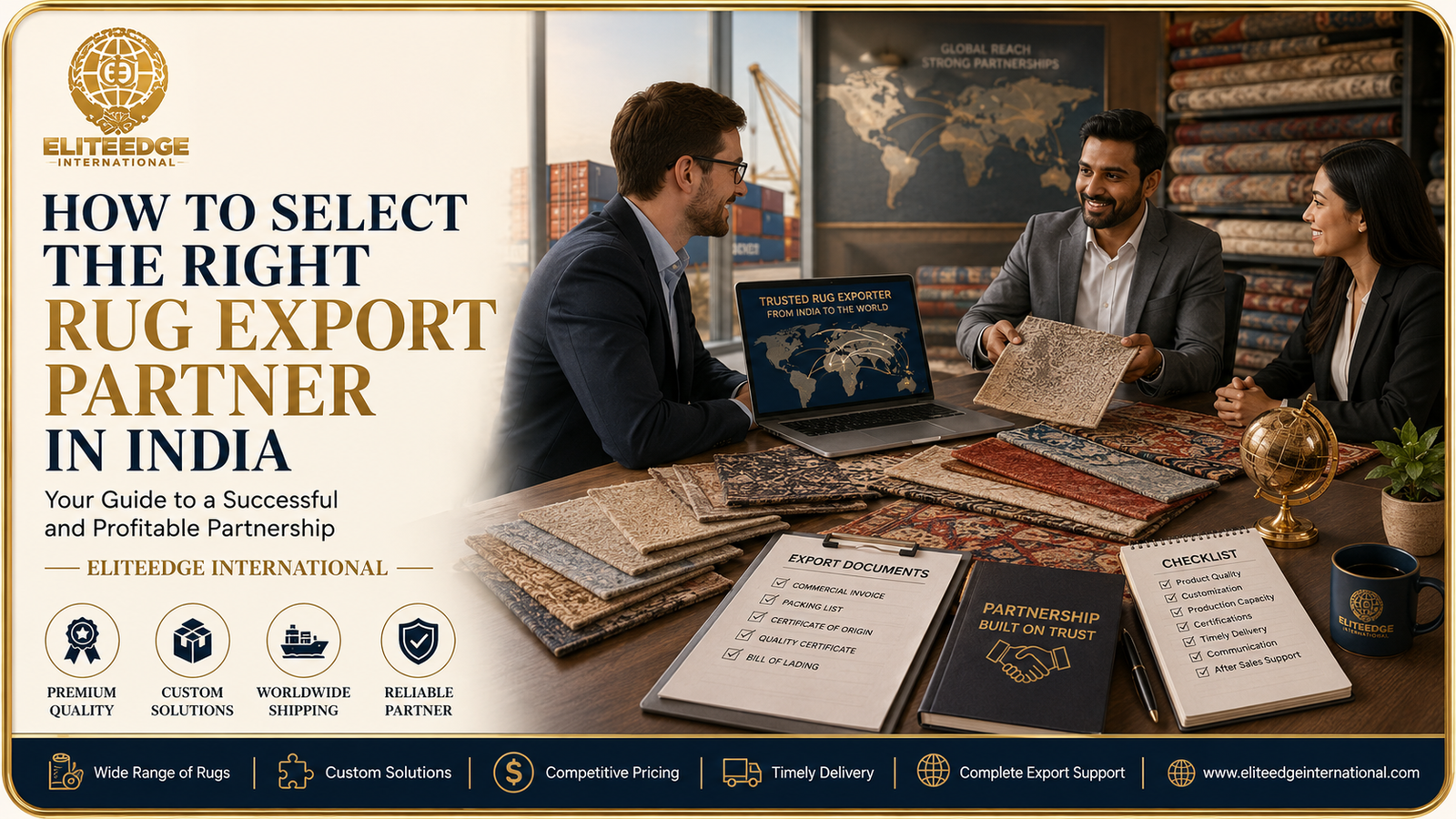
Finding a trusted rug exporter in India can make a significant difference to the success of an international home-textile business. A rug may look like a relatively simple product, but behind every successful shipment are decisions involving yarn, weaving, finishing, dimensions, color consistency, packaging, inspection, documentation, freight, and delivery schedules. Choose the right export partner and the process can feel almost effortless; choose poorly and even a beautiful product can become a source of delays, quality complaints, unexpected costs, and unhappy customers. India has a long-established carpet and rug manufacturing ecosystem, with important production clusters and an export industry serving buyers across international markets. The Carpet Export Promotion Council has also continued to highlight new trade opportunities and export-support initiatives for Indian carpet and rug businesses in 2026.
For an importer, retailer, interior-design company, hospitality buyer, or private-label brand, the objective should therefore not be to find the cheapest supplier. The better objective is to identify a reliable rug export partner that can consistently deliver the right product at the agreed quality, quantity, price, and time. Think of the relationship like building a bridge between two markets. Your business stands on one side, your customers on the other, and the exporter provides much of the structure connecting them. If that structure is weak, every order becomes risky. If it is strong, you can gradually increase volumes, introduce new collections, develop custom designs, and create a dependable supply chain.
Why Choosing the Right Rug Exporter Matters
Selecting an exporter is more important than simply comparing product photographs and quotations. A professional exporter should understand that international buyers are purchasing more than rugs; they are purchasing consistency, predictability, communication, and confidence. A supplier might offer an attractive price for a single shipment but struggle when you need repeat production, matching colors, revised dimensions, customized labels, or strict packaging instructions. On the other hand, a slightly higher-priced manufacturer may provide stronger quality control and smoother logistics, ultimately reducing the hidden costs associated with rejected goods and missed deadlines.
The Indian carpet and rug sector has substantial international significance. CEPC stated in 2025 that India's handmade carpet sector employs more than 2.5 million artisans and contributes nearly USD 2 billion in annual exports, illustrating the scale and depth of the ecosystem. The sector is also evolving with changing trade opportunities, including developments involving FTAs and export-promotion initiatives. This makes India an attractive sourcing destination, but the size of the industry also means that buyers should carefully distinguish between manufacturers, traders, agents, and experienced export-oriented businesses.
The Difference Between a Supplier and an Export Partner
A supplier primarily focuses on providing a product. An export partner thinks about the entire transaction. That includes confirming specifications, preparing samples, coordinating production, inspecting finished goods, arranging suitable export packaging, preparing documentation, communicating shipment details, and helping ensure that the order reaches the destination correctly. This distinction becomes particularly important when your business operates internationally and cannot easily visit the factory every time you place an order.
A useful question is simple: “If something goes wrong with this shipment, who will help me solve it?” The answer tells you a great deal about the quality of the partnership you are considering. A reliable exporter should be willing to discuss potential problems before they happen rather than disappearing once the purchase order has been confirmed.
Understand Your Rug Sourcing Requirements
Before contacting exporters, define exactly what you want to buy. This sounds obvious, but vague requirements often create unnecessary confusion during international sourcing. A buyer might initially say they need “premium rugs,” while the exporter needs to know whether that means polypropylene, cotton, wool, jute, recycled materials, flatweave construction, tufted construction, printed designs, machine-made products, or handmade rugs. Even seemingly small differences can affect pricing, manufacturing time, packaging volume, and the final appearance of the product.
Prepare a sourcing specification that includes rug material, construction, dimensions, weight, pile height, colors, patterns, edging, backing, intended use, packaging, labeling, quantity, destination country, and target price range. If you are developing a retail collection, also specify whether products need barcodes, hangtags, carton labels, private branding, individual polybags, or special folding instructions. The more clearly you define your requirements, the easier it becomes to compare exporters on an equal basis.
Define Material, Size, Design, and Quantity
Material should be one of the first decisions. For example, a polypropylene rug designed for outdoor or high-traffic use has different performance expectations from a decorative indoor rug made for a premium home collection. Likewise, a buyer ordering hundreds of identical rugs has different production requirements from a retailer ordering dozens of designs in smaller quantities.
Ask the exporter to provide technical information rather than relying entirely on marketing descriptions. Confirm dimensions, material composition, construction method, GSM or weight where applicable, color specifications, backing, finishing, and tolerance levels. If your products will be sold under your own brand, document these specifications in an approved product sheet. That document can become the reference point for future production and reduce disputes about what “same quality” actually means.
Check the Exporter's Manufacturing Capabilities
A professional rug exporter in India should be able to explain how your products are manufactured and where quality checks occur. This does not necessarily mean every exporter must own every machine or process in-house. Some established businesses use a network of specialized manufacturing units. What matters is whether the exporter has effective control over production and can maintain consistent specifications across orders.
Ask about manufacturing capacity, production planning, raw-material sourcing, weaving or tufting processes, finishing, inspection, and storage. If you require large volumes, ask how the company handles production peaks. A supplier that can comfortably produce 500 pieces may not automatically be capable of producing 10,000 pieces while maintaining identical quality. Capacity should therefore be evaluated against your realistic order size rather than based on impressive claims.
Evaluate Production Capacity and Quality Control
Quality control should exist at several stages, not only at the end of production. Raw materials should meet agreed specifications, dimensions should be checked during production, colors should be monitored, and finished rugs should be inspected before packing. For larger orders, you can also establish an agreed inspection procedure covering acceptable tolerances, visible defects, stains, loose threads, uneven edges, color variation, and packaging damage.
Request photographs or videos of the production and inspection process where appropriate. If you are sourcing premium products, consider arranging an independent pre-shipment inspection for important orders. The goal is not to create bureaucracy; it is to establish a repeatable system where both buyer and exporter understand what constitutes an acceptable shipment.
Verify Export Experience and Market Knowledge
Manufacturing a rug and exporting a rug are two different capabilities. International shipments involve commercial terms, freight coordination, customs processes, documentation, packaging specifications, and destination-market requirements. An exporter experienced in overseas transactions will generally be more familiar with these practical details.
Ask which countries the company regularly serves and whether it has handled products similar to yours. You do not necessarily need a supplier that exports to every country in the world. You need one that understands your destination market and can communicate clearly about its requirements. Ask for references, shipment examples, or anonymized documentation when commercially appropriate.
Review International Shipping and Documentation Expertise
Export documentation deserves particular attention. India's Directorate General of Foreign Trade identifies documents such as the commercial invoice cum packing list, shipping bill/bill of export, and transport document among the mandatory export documentation framework, with additional documents potentially required depending on the goods and circumstances. A capable exporter should therefore understand how the documentation for your shipment will be prepared and coordinated rather than treating paperwork as an afterthought.
Certificate-of-origin requirements can also vary according to the destination and applicable trade agreement. India's DGFT operates a common digital platform for Certificates of Origin, including preferential certificates under applicable FTAs/PTAs. Ask your exporter which documents will be supplied, who prepares them, and which documents you will receive after shipment. Your freight forwarder or customs broker should also confirm destination-specific requirements.
Assess Rug Quality Before Placing a Large Order
Never judge a potential export partner solely from a website or catalogue. Samples are one of the most valuable tools in international rug sourcing. A photograph cannot tell you everything about softness, thickness, construction, backing, edge finishing, color accuracy, weight, foldability, or overall workmanship.
Request samples that represent the actual production method you intend to order. If you are buying several constructions, ask for examples of each. Examine the rug under normal lighting and, where possible, compare it with the specifications provided by the exporter. For a private-label collection, keep an approved sample as a physical benchmark for future production.
Request Samples and Product Specifications
When reviewing a sample, inspect the edges, corners, surface, backing, stitching, color, dimensions, and overall finish. Measure the rug rather than assuming the stated dimensions are exact. If the product is intended for outdoor use, ask about resistance to moisture, UV exposure, mold, mildew, and fading where relevant to the construction and materials.
Do not hesitate to ask why a particular material or construction was recommended. An experienced exporter should be able to explain the reasoning behind product choices. That conversation can reveal whether the company is simply trying to sell an existing product or genuinely understands your commercial requirements.
Evaluate Customization and Private Label Services
Customization can be a major advantage when working with an Indian rug manufacturer or exporter. Retailers and brands may require specific sizes, colors, patterns, materials, logos, labels, packaging, or collections designed around their target market. A supplier that can support these requirements can become much more valuable than a company offering only ready-made designs.
Ask about OEM and private-label manufacturing, minimum order quantities, artwork requirements, sampling charges, color matching, custom packaging, printed labels, woven labels, hangtags, and carton markings. Establish which customization requests are included in the quotation and which incur additional charges.
Confirm OEM and Packaging Capabilities
Packaging should be discussed before production begins. Rugs may need to be folded, rolled, compressed, wrapped, boxed, or palletized depending on the product and destination. The correct packaging protects the goods while also controlling shipping volume. A poor packaging decision can increase freight costs or result in damaged products.
For private-label orders, request packaging artwork approval before mass production. Confirm spelling, product descriptions, country-of-origin statements, barcode placement, carton dimensions, and shipping marks. Small errors printed on thousands of packages can be expensive to correct later.
Compare Pricing Beyond the Initial Quote
Price matters, but the lowest quotation is rarely enough to identify the best export partner. Compare what each quotation actually includes. One supplier might quote a lower factory price but charge separately for packaging, labels, sampling, customization, inspection, or documentation. Another might provide a higher unit price while including more services and stronger quality controls.
A useful comparison should consider product cost, customization cost, packaging, inland transportation, inspection, documentation, freight terms, payment conditions, and expected defect rates. Ask whether the quotation is based on EXW, FOB, CIF, or another Incoterm, and make sure everyone understands exactly what is included.
|
Factor |
Questions to Ask |
|
Product price |
What exactly is included in the unit price? |
|
Customization |
Are custom colors, sizes, and designs charged separately? |
|
Packaging |
Is export-ready packaging included? |
|
MOQ |
What is the minimum order quantity per design or size? |
|
Lead time |
How many days are required after approval? |
|
Inspection |
Can third-party inspection be arranged? |
|
Shipping |
Which Incoterm is being quoted? |
|
Documentation |
Which export documents are supplied? |
|
Payment |
What are the deposit and balance conditions? |
|
Reorders |
Will the same specifications be maintained for repeat orders? |
Check Export Documentation and Compliance
Documentation is one of the easiest areas to overlook until a shipment is already moving. A trustworthy exporter should provide clear information about the documents associated with your order and should be able to coordinate with your freight forwarder. DGFT guidance identifies the commercial invoice, packing list, shipping bill, and transport document as important elements of India's export documentation process.
Depending on your destination and transaction, additional documents may be needed. DGFT material also identifies items such as certificates of origin, inspection certificates where necessary, and other documents that can apply depending on the shipment or buyer requirements. Do not assume that every document is automatically required for every rug shipment. Instead, ask the exporter and your customs/logistics professionals to confirm the requirements for your specific destination.
Examine Packaging and International Logistics
The journey from an Indian factory to an overseas warehouse can involve multiple handling points. Your rug exporter should therefore understand how to prepare goods for international transportation. Ask about carton strength, moisture protection, palletization, container loading, weight limits, shipping marks, and product protection.
Logistics planning should begin before the goods are finished. If your order is time-sensitive, confirm the production completion date and estimated cargo handover date. Also establish who is responsible for booking freight, providing shipping instructions, and sending the final shipping documents.
Evaluate Communication and Responsiveness
Good communication is one of the strongest indicators of a successful export relationship. You are likely to exchange numerous messages during product development, sampling, production, inspection, and shipment. If the exporter takes days to answer basic questions before receiving your order, communication may become even harder once production has started.
Pay attention to how the company handles detailed questions. Does it provide direct answers? Does it clarify ambiguous specifications? Does it acknowledge mistakes? Does it keep written records of approved designs and samples? A responsive exporter can save you hours of frustration and prevent misunderstandings that would otherwise become expensive.
Review Certifications, Registrations, and Industry Credentials
Credentials can help establish credibility, but they should be evaluated intelligently. Ask for relevant registrations, memberships, certifications, test reports, and other documentation applicable to the products and markets you serve. Verify important credentials rather than accepting a logo displayed on a website at face value.
For businesses involved in India's carpet-export ecosystem, CEPC provides industry membership and export-related support. Its current 2026 information also shows ongoing activity around export promotion, trade facilitation, FTAs, financing, exhibitions, and international market opportunities. Membership alone does not guarantee product quality, but verified industry participation can be one useful part of your overall due-diligence process.
Ask About Production Lead Times
Lead time can directly affect your inventory and sales. A supplier that promises an unrealistically short production period may be more dangerous than one that provides a longer but achievable schedule. Ask for separate estimates for sampling, raw-material procurement, production, finishing, inspection, packing, and dispatch.
For repeat orders, ask whether lead times can improve once the product specification has been established. You should also ask how the exporter handles unexpected events such as raw-material shortages, machine downtime, labor constraints, port disruptions, or sudden increases in demand. A mature export partner will discuss contingency planning rather than simply promising that nothing will go wrong.
Assess Sustainability and Responsible Manufacturing
Sustainability is increasingly important to retailers, designers, hospitality companies, and end consumers. If sustainability is part of your brand positioning, ask detailed questions rather than relying on broad claims such as “eco-friendly” or “green.” Ask what materials are used, whether recycled or natural fibers are available, how dyes and finishing processes are managed, and what packaging materials are used.
You should also consider durability as part of sustainability. A rug that lasts longer and maintains its appearance can reduce replacement frequency. If environmental claims are important to your buyers, request supporting documentation or test reports where applicable. Responsible sourcing should be treated as a measurable commercial requirement rather than simply a marketing phrase.
Compare Potential Rug Export Partners
Once you have shortlisted several companies, use a consistent evaluation method. Create a scorecard covering quality, pricing, customization, manufacturing capacity, export experience, communication, documentation, sustainability, packaging, and delivery performance. This prevents a very attractive price from overshadowing serious weaknesses in other areas.
A simple weighted assessment can help:
- Product quality: 25%
- Manufacturing capability: 15%
- Export experience: 15%
- Pricing and commercial terms: 15%
- Customization: 10%
- Quality control: 10%
- Communication and service: 5%
- Sustainability and credentials: 5%
The percentages can change according to your business. A luxury retailer may give quality a much higher weighting, while a high-volume promotional buyer may focus more heavily on price and production capacity. The important point is to compare exporters using the same criteria.
Red Flags to Watch for When Choosing an Exporter
Several warning signs deserve attention. A company that refuses to provide basic product specifications, avoids discussing samples, gives inconsistent prices, cannot explain its export process, or repeatedly changes promised lead times should be treated cautiously. The same applies to businesses that pressure you to make immediate payments without providing clear commercial documentation.
Another red flag is a quotation that seems dramatically lower than every comparable supplier without a convincing explanation. Very low prices may result from differences in material quality, construction, packaging, labor, finishing, or what is actually included in the quotation. The objective is not to eliminate every inexpensive supplier; it is to understand why the price is low.
Questions to Ask a Rug Exporter Before Ordering
Before placing your first substantial order, ask practical questions that expose the supplier's actual capabilities. You can request information about factory capacity, product specifications, sample approval, MOQ, production timelines, packaging, inspection, export documentation, payment terms, and after-sales support.
Some of the most useful questions include:
- Are you a manufacturer, exporter, trader, or a combination of these?
- Which rug constructions and materials do you specialize in?
- Can you manufacture custom sizes, colors, and designs?
- What is your MOQ for custom products?
- Can you provide pre-production and production samples?
- What quality-control process do you follow?
- Which export markets do you currently serve?
- Which export documents will you provide?
- What packaging options are available for international shipping?
- What happens if the delivered goods do not meet the approved specifications?
The quality of the answers matters as much as the answers themselves. A serious exporter should be comfortable discussing these subjects.
Building a Long-Term Partnership With an Indian Rug Exporter
The best sourcing relationship develops gradually. Start with samples and a manageable commercial order, document the specifications, monitor quality, evaluate delivery performance, and then increase volumes as confidence grows. This approach gives both sides time to understand each other's expectations.
Once a supplier proves reliable, consider developing a broader relationship. You may collaborate on seasonal collections, exclusive patterns, private-label ranges, new materials, or region-specific products. A strong exporter can become an extension of your purchasing and product-development team rather than simply another vendor in your database.
Why India Remains an Important Rug Sourcing Destination
India offers buyers a combination of manufacturing heritage, skilled craftsmanship, established export networks, diverse materials, and the ability to produce both traditional and contemporary designs. Major carpet-producing regions have developed specialized capabilities over generations, while modern exporters increasingly combine traditional techniques with contemporary manufacturing and international logistics.
Current industry developments also indicate continued attention to expanding export opportunities. CEPC's 2026 updates include initiatives involving India–New Zealand trade, India–Oman CEPA, India–UK and India–EU trade opportunities, international exhibitions, financing schemes, and export facilitation. These developments make it particularly important for buyers to work with exporters who actively understand international trade rather than companies focused only on domestic sales.
Conclusion
Choosing the right trusted rug exporter in India should be treated as a strategic sourcing decision, not simply a price-shopping exercise. The ideal partner combines dependable product quality with manufacturing capability, transparent pricing, customization support, export documentation expertise, reliable packaging, responsive communication, and realistic delivery commitments. Start by defining your requirements, request representative samples, verify manufacturing and export capabilities, compare complete landed costs, and conduct proper due diligence before committing to large volumes.
The strongest export relationships are built on consistency. When your exporter understands your specifications, maintains approved quality, communicates clearly, prepares documentation correctly, and delivers on schedule, your business can focus on what matters most: selling excellent products to your customers. India offers a deep and evolving rug-export ecosystem, but the real advantage comes from selecting a partner whose capabilities match your business goals. Take the time to evaluate carefully at the beginning, and you can turn an ordinary supplier relationship into a long-term international sourcing partnership.
FAQs
1. How do I find a trusted rug exporter in India?
Start by identifying exporters with relevant manufacturing and international-market experience. Review their product range, request samples, verify business credentials, ask about quality-control procedures, and assess their export documentation capabilities. It is also useful to begin with a smaller order before committing to a large production program.
2. What should I check in a rug sample?
Check the material, construction, dimensions, weight, color consistency, backing, edge finishing, stitching, surface appearance, and overall workmanship. Compare the physical sample against the written specification. If the rug will be sold under your brand, retain an approved reference sample for future production.
3. Can Indian rug exporters provide private-label products?
Many export-oriented rug manufacturers can support OEM and private-label production, including custom sizes, colors, designs, labels, packaging, and branding. However, capabilities and minimum order quantities vary, so confirm these details before placing an order.
4. What export documents should a rug buyer expect?
The exact documentation depends on the shipment and destination, but India's DGFT framework identifies documents including the commercial invoice cum packing list and shipping bill/bill of export, along with the applicable transport document. Additional documents, such as a Certificate of Origin, may apply depending on the destination and trade arrangement.
5. Is the cheapest Indian rug exporter always the best choice?
No. A low unit price can become expensive if it comes with inconsistent quality, poor packaging, delays, weak communication, or unexpected charges. Compare the total commercial value of the partnership, including product quality, customization, logistics, documentation, reliability, and after-sales support, rather than looking only at the initial unit price.