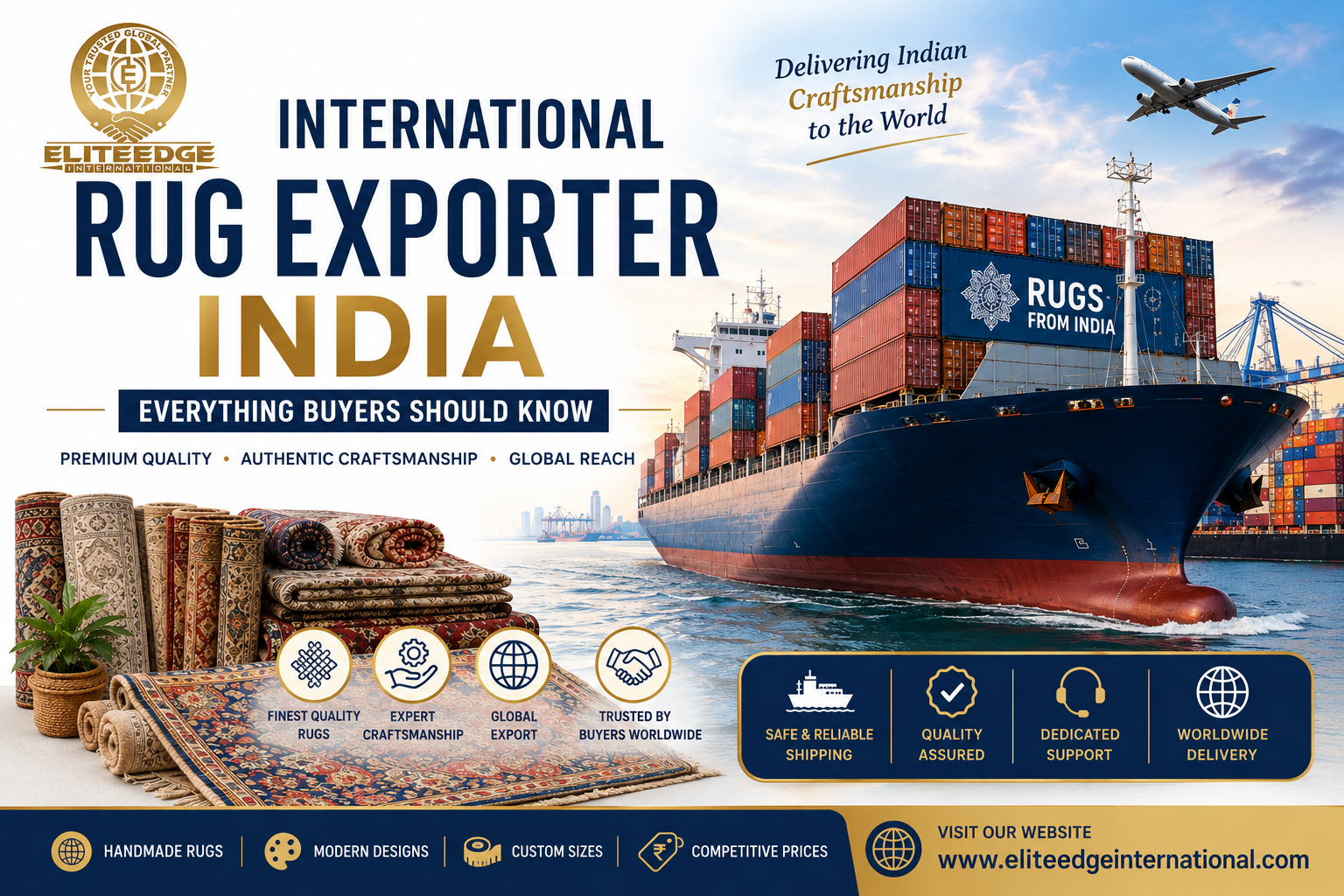
International Rug Exporter India: Everything Buyers Should Know
India has earned a remarkable reputation as one of the world's leading producers and exporters of premium rugs and carpets. From handcrafted wool masterpieces woven in Bhadohi to contemporary polypropylene rugs manufactured with advanced machinery, Indian exporters serve retailers, wholesalers, interior designers, hotel chains, and distributors across more than 70 countries. According to industry data, India's carpet exports reached US$ 1.54 billion in FY2024–25, highlighting the country's continued strength in global home furnishing markets. The United States remains the largest destination, followed by Germany, the United Kingdom, Canada, Australia, and several European nations.
If you're searching for a reliable international rug exporter India, understanding how the industry works can save you time, money, and costly import mistakes. Buying directly from Indian manufacturers often provides better pricing, customization opportunities, private labeling options, and access to centuries-old craftsmanship that machine-produced alternatives cannot easily replicate. Yet successful importing requires more than finding a supplier—you also need to understand product types, quality standards, certifications, shipping methods, export documentation, and global market trends.
This comprehensive guide explains everything international buyers should know before sourcing rugs from India, whether you're importing a single container or building a long-term wholesale partnership.
India's Position in the Global Rug Export Market
India isn't simply another textile manufacturing nation—it is widely recognized as the world's largest exporter of handmade carpets. The country's weaving tradition dates back hundreds of years, combining Persian influences with regional Indian artistry to create products admired in luxury homes, hotels, museums, and commercial spaces worldwide. Today, Indian exporters supply both handmade and machine-made rugs in an incredible variety of materials, colors, textures, and price ranges.
The scale of India's export industry is equally impressive. Government export reports show carpet exports rising to approximately US$1.54 billion during FY2024–25, reflecting a healthy recovery in international demand. More than half of these exports are shipped to the United States, while Europe continues to represent another significant share of the market. This strong international presence has encouraged manufacturers to invest in modern production technology, sustainable raw materials, and stricter quality control systems to meet global buyer expectations.
For international buyers, India's dominance means greater product availability, flexible production capacity, experienced exporters, and mature logistics infrastructure. Instead of sourcing from multiple countries, many wholesalers now consolidate their rug procurement through Indian suppliers because they can obtain handmade luxury rugs, affordable machine-made collections, outdoor rugs, and customized private-label products from a single manufacturing ecosystem.
Why International Buyers Choose Indian Rug Exporters
Heritage Meets Modern Manufacturing
One of India's greatest strengths is its ability to combine traditional craftsmanship with industrial-scale manufacturing. Handmade rugs are still woven by skilled artisans using techniques passed through generations, while modern factories produce high-volume collections using computerized looms and precision finishing equipment. This unique combination allows buyers to source everything from exclusive designer collections to mass-market retail products from the same country.
Handmade rugs often carry a story that appeals to premium consumers. Every knot reflects artisan skill, and subtle variations make each rug genuinely unique rather than mechanically identical. Luxury retailers particularly value these characteristics because customers increasingly seek authentic products with cultural heritage instead of purely machine-produced décor. At the same time, machine-made collections offer consistency, faster lead times, and attractive pricing for large retail chains.
The coexistence of these two production models gives Indian exporters remarkable flexibility. Whether your business targets boutique interior designers or multinational furniture retailers, you'll find manufacturers capable of matching your volume, design language, and quality expectations.
Competitive Pricing Without Compromising Quality
Price remains a major reason why global buyers source rugs from India. The country benefits from abundant textile expertise, integrated supply chains, skilled labor, and access to quality natural fibers including wool, cotton, and jute. These advantages help manufacturers produce premium rugs at costs that remain competitive in international markets.
Lower manufacturing costs do not necessarily mean lower quality. Reputable exporters follow international inspection procedures, maintain standardized production processes, and conduct multiple quality checks before packaging. Buyers frequently receive better value because they're purchasing directly from manufacturers rather than trading intermediaries.
Another financial advantage is production flexibility. Many exporters accept customized quantities, mixed container orders, and OEM manufacturing, allowing importers to optimize inventory without excessive upfront investment. This flexibility is especially valuable for growing brands launching new rug collections.
Types of Rugs Exported from India
India manufactures an exceptionally broad range of rugs suited for residential, hospitality, commercial, and outdoor applications. Understanding these categories helps buyers choose products aligned with their target markets.
Handmade Wool Rugs
Handmade wool rugs represent India's flagship export category. These rugs are admired for their durability, luxurious texture, thermal insulation, and intricate artistic designs. Hand-knotted wool rugs often require months of weaving and are commonly positioned within premium and luxury home décor segments.
Because wool naturally resists dirt and retains color well, these rugs remain popular among interior designers and hospitality projects. Buyers can request contemporary abstract patterns, traditional oriental motifs, Scandinavian minimalism, or completely customized artwork depending on manufacturer capabilities.
Cotton and Flatweave Rugs
Cotton rugs provide a lightweight and affordable alternative for casual living spaces. Flatweave dhurries have become increasingly popular because they're reversible, easy to maintain, and ideal for modern interiors. Their versatility makes them attractive for online retailers and furniture stores seeking fashionable yet accessible products.
These rugs are particularly suitable for bedrooms, kitchens, apartments, and vacation rentals where practicality matters as much as aesthetics. Exporters frequently offer custom color palettes to match seasonal collections.
Polypropylene & Outdoor Rugs
Synthetic polypropylene rugs have experienced rapid international growth due to their weather resistance. These products perform exceptionally well in balconies, patios, gardens, camping environments, and high-traffic commercial areas. UV stabilization, moisture resistance, and easy cleaning make them ideal for outdoor living trends across Europe and North America.
Many international retailers now prioritize recyclable polypropylene collections because consumers increasingly value durable products with longer usable life.
Jute and Natural Fiber Rugs
Natural fiber rugs satisfy growing demand for sustainable home furnishings. Jute, hemp, and blended natural fibers create earthy textures that complement contemporary organic interior styles. These rugs appeal strongly to environmentally conscious consumers and often feature minimalist woven aesthetics suitable for Scandinavian and bohemian décor.
Major Rug Manufacturing Regions in India
India's rug industry is concentrated across several specialized manufacturing clusters, each known for distinct weaving traditions and production capabilities. Understanding these regions helps buyers identify suppliers with expertise matching their product requirements.
Bhadohi, located in Uttar Pradesh, is widely regarded as India's carpet capital. Thousands of artisans and manufacturers operate here, producing hand-knotted, hand-tufted, and handwoven rugs exported to luxury markets worldwide. The region has developed extensive export infrastructure, making it particularly attractive for international wholesale buyers.
Mirzapur complements Bhadohi with strong expertise in traditional handmade carpets. Many exporters maintain production facilities across both cities, allowing them to handle larger orders while preserving artisanal craftsmanship.
Jaipur has built an international reputation for designer rugs featuring vibrant colors, contemporary patterns, and innovative textile techniques. Buyers targeting premium lifestyle brands often source collections from manufacturers in Rajasthan.
Panipat, meanwhile, specializes in cotton rugs, recycled textiles, and machine-made floor coverings. This region is especially important for affordable home furnishing collections and sustainable textile products.
Together, these manufacturing hubs create one of the world's most diverse rug sourcing ecosystems, offering virtually every style, material, and production method under one national supply chain.
Understanding Export Quality Standards
International buyers should never evaluate rugs based solely on appearance. True export quality depends on material selection, weaving density, finishing consistency, dimensional accuracy, and long-term durability. Reliable Indian exporters typically implement multiple inspection stages before shipment to ensure products meet overseas retail standards.
Materials and Construction
The foundation of a quality rug begins with its raw materials. Premium wool should feel resilient and naturally soft without excessive shedding. Cotton backing must provide structural stability, while synthetic fibers should demonstrate uniform weaving and strong edge binding. Construction quality directly influences lifespan, especially for high-traffic residential and commercial environments.
Buyers should request detailed specifications including pile height, GSM, knot density, yarn composition, and backing materials before approving production. These technical details provide much better quality indicators than photographs alone.
Color Fastness and Durability
Color consistency is another critical export requirement. Rugs shipped internationally may encounter humidity changes, sunlight exposure, and extended transportation periods. Professional exporters therefore test color fastness, washing resistance, abrasion performance, and dimensional stability before packaging.
Durability also depends on finishing techniques. Proper latex application, secure edge stitching, and accurate trimming significantly reduce warranty claims after import. Experienced buyers often request pre-shipment inspection reports to verify these quality benchmarks before container loading.
Private Label & OEM Rug Manufacturing
One of the biggest advantages of working with an international rug exporter India is access to private labeling and OEM manufacturing. Rather than selling generic products, retailers can develop exclusive collections carrying their own brand identity. This approach increases profit margins while strengthening customer loyalty.
OEM manufacturing typically includes customized sizes, exclusive patterns, branded labels, personalized packaging, barcode application, and retail-ready presentation. Some manufacturers also assist with design development, transforming buyer sketches into production-ready rug collections.
Private labeling has become particularly valuable for e-commerce brands competing in crowded home décor markets. Instead of competing on identical products, businesses can launch distinctive collections unavailable through competitors. Indian manufacturers are often willing to accommodate these projects even at moderate production volumes, making OEM accessible for both established retailers and emerging brands.
Export Documentation Every Buyer Should Know
Successful international importing depends as much on documentation as product quality. Missing paperwork can delay customs clearance, increase storage costs, and create unnecessary complications at destination ports. Professional Indian exporters usually prepare complete documentation packages, but buyers should understand what each document represents.
|
Document |
Purpose |
|
Commercial Invoice |
Declares product value for customs |
|
Packing List |
Details carton and container contents |
|
Bill of Lading |
Confirms shipment ownership and transport |
|
Certificate of Origin |
Identifies manufacturing country |
|
Fumigation Certificate |
Required for certain wooden packaging |
|
Inspection Certificate |
Verifies quality when requested |
Before production begins, buyers should also confirm HS codes, destination country regulations, labeling requirements, and preferred Incoterms such as FOB, CIF, or DDP. Clear contractual agreements reduce misunderstandings and create smoother international transactions.
Experienced exporters frequently coordinate with freight forwarders and customs agents, allowing buyers to focus on inventory planning rather than complex shipping procedures.
Shipping Methods and Global Logistics
Rugs are generally exported via sea freight because it offers the most economical solution for bulky textile products. Twenty-foot and forty-foot containers are commonly used depending on shipment volume. Exporters carefully roll, wrap, compress, and palletize rugs to maximize container efficiency while protecting product quality during long-distance transportation.
Lead times vary according to production method. Machine-made rugs may be ready within several weeks, whereas handcrafted collections often require substantially longer weaving periods depending on complexity and quantity. Buyers planning seasonal retail launches should therefore finalize orders well in advance of required delivery dates.
Packaging deserves special attention because international transit exposes products to moisture, dust, compression, and repeated handling. High-quality exporters use moisture-resistant wrapping, durable woven bags, reinforced cartons, and clear product labeling to minimize damage throughout the logistics journey.
How to Choose the Right International Rug Exporter
Selecting the right supplier involves much more than comparing quotations. A trustworthy exporter demonstrates consistent communication, transparent manufacturing capabilities, documented export experience, and willingness to provide samples before bulk production. Buyers should evaluate operational reliability alongside pricing.
Start by reviewing the company's export history and primary international markets. Manufacturers regularly supplying North America and Europe are often more familiar with international compliance requirements, packaging standards, and retailer expectations. Product photography alone should never replace genuine production evidence.
Request physical samples whenever possible. Touch, texture, weaving quality, color accuracy, and finishing cannot be judged perfectly through digital images. Sample evaluation frequently prevents expensive surprises during container deliveries.
Questions worth asking include minimum order quantities, customization capabilities, production capacity, inspection procedures, payment terms, and average lead times. Reliable exporters answer these questions confidently and provide written specifications supporting their claims.
Common Mistakes First-Time Importers Make
New importers often become overly focused on achieving the lowest possible price. Ironically, the cheapest quotation frequently becomes the most expensive decision once quality problems, delayed shipments, or customer returns appear. Long-term profitability depends on consistency rather than minimal unit cost.
Another common mistake is skipping sample approval. Even experienced manufacturers interpret colors, textures, and dimensions differently unless buyers provide precise specifications. Approving production without physical confirmation increases the risk of receiving products that don't match retail expectations.
Documentation oversight also creates avoidable delays. Buyers should verify invoices, packing lists, labeling requirements, and destination customs regulations before shipment departure rather than after containers arrive.
Communication matters equally. Maintaining written production approvals, artwork confirmations, packaging instructions, and delivery schedules helps prevent misunderstandings throughout the manufacturing process. Strong supplier relationships usually produce better results than transactional purchasing alone.
Future Trends in India's Rug Export Industry
The future of India's rug export industry looks increasingly driven by sustainability, design innovation, and premium craftsmanship. Global consumers are shifting toward products with authentic stories, ethical production methods, and environmentally responsible materials. This trend strongly favors Indian manufacturers, whose artisanal heritage naturally aligns with growing demand for handmade and sustainable home décor.
Natural fibers such as jute, cotton, recycled textiles, and responsibly sourced wool continue gaining popularity across international markets. At the same time, manufacturers are introducing recyclable polypropylene collections that combine outdoor durability with improved environmental performance. Digital design technology is also enabling faster customization, allowing buyers to create exclusive collections with shorter development cycles.
Trade diversification represents another important trend. While the United States remains India's largest export destination, exporters are expanding partnerships across Europe, the Middle East, Australia, and emerging global markets to reduce dependence on any single region. Industry initiatives, international trade fairs, and stronger branding of Indian handmade craftsmanship are expected to support continued export growth in the coming years.
Conclusion
Choosing the right international rug exporter India can transform your sourcing strategy and strengthen your business for years to come. India offers an exceptional combination of traditional craftsmanship, modern manufacturing, competitive pricing, flexible OEM production, and reliable global logistics. Whether your focus is luxury handmade wool rugs, sustainable natural fiber collections, or affordable outdoor polypropylene products, Indian manufacturers provide solutions for virtually every market segment.
The most successful buyers look beyond price alone. They evaluate production quality, communication, customization capabilities, export experience, and long-term partnership potential. By understanding materials, documentation, shipping processes, and quality standards, you can reduce importing risks while delivering products your customers genuinely value.
As global demand continues shifting toward authentic and sustainable home furnishings, India's position as a world-leading rug exporter remains stronger than ever. Building relationships with experienced exporters today can create lasting opportunities in one of the fastest-growing segments of the international home décor industry.
FAQs
1. Why is India famous for rug exports?
India is the world's leading exporter of handmade carpets and rugs, known for centuries-old weaving traditions, skilled artisans, diverse designs, and high-quality materials such as wool, cotton, silk, and jute. The country exports to more than 70 countries worldwide.
2. What are the most popular rugs exported from India?
The most popular export categories include hand-knotted wool rugs, hand-tufted rugs, cotton dhurries, jute rugs, polypropylene outdoor rugs, and customized designer area rugs for residential and commercial markets.
3. Can international buyers order private-label rugs from India?
Yes. Many Indian manufacturers offer OEM and private-label services, including custom sizes, exclusive patterns, branded labels, personalized packaging, barcode printing, and retail-ready packaging for wholesalers and retailers.
4. Which countries import the most rugs from India?
The United States is India's largest rug importer, followed by Germany, the United Kingdom, Canada, Australia, France, Italy, and several other European markets.
5. What should buyers check before selecting a rug exporter?
Buyers should verify export experience, product quality, sample approval, manufacturing capacity, certifications, inspection procedures, shipping terms, communication responsiveness, and the supplier's ability to meet customization requirements.