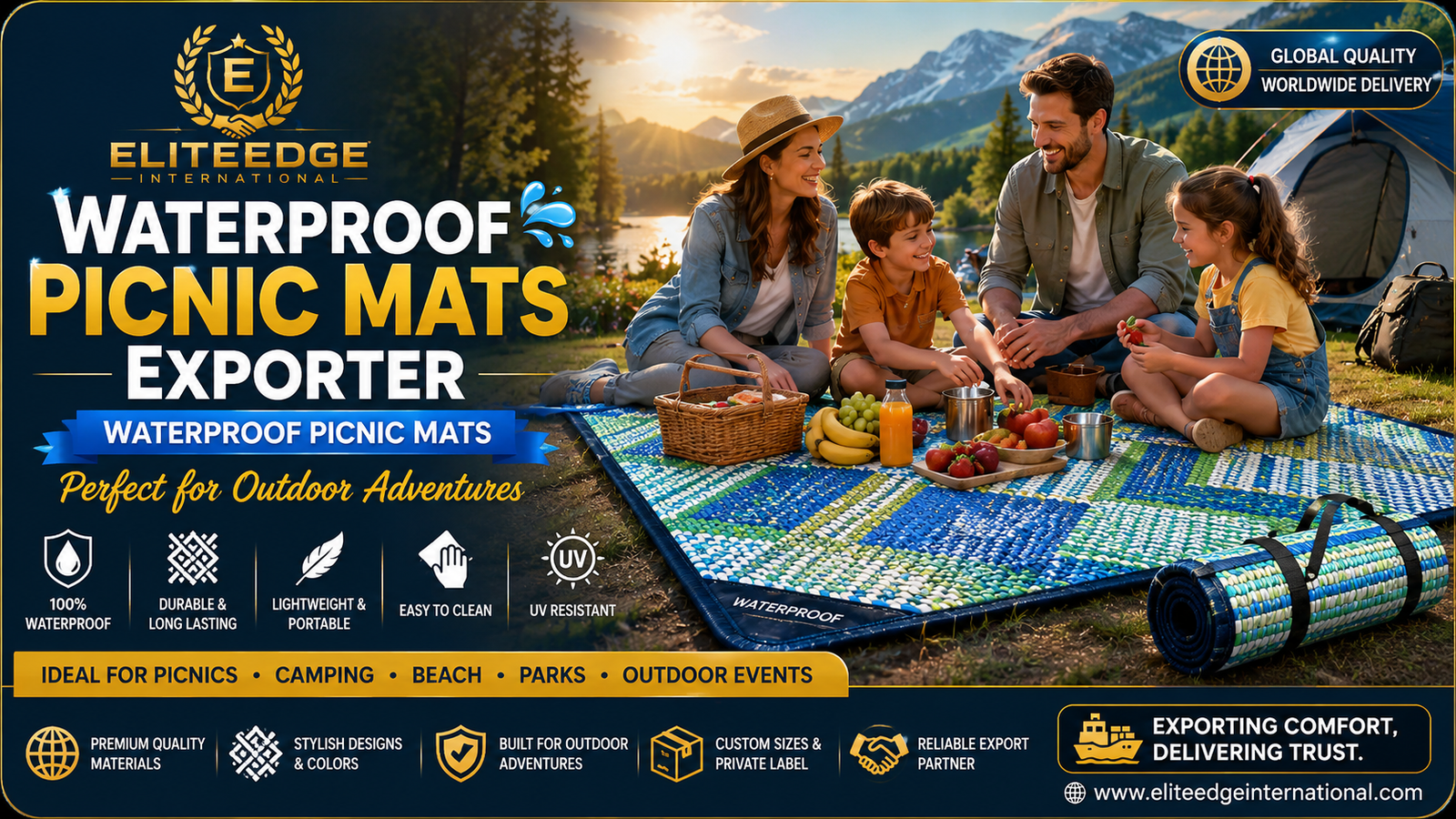
Waterproof Picnic Mats Exporter: Waterproof Picnic Mats for Outdoor Adventures
Planning a picnic sounds simple until you arrive at the perfect outdoor spot and discover that the grass is damp, the soil is muddy, or an unexpected shower has turned your comfortable sitting area into a soggy mess. That is exactly where waterproof picnic mats make a difference. Designed for outdoor comfort while helping users stay separated from wet or dirty ground, these mats have become practical products for families, campers, beachgoers, event organizers, retailers, and outdoor-lifestyle brands. For international buyers, choosing the right waterproof picnic mats exporter is about much more than finding a low price. It involves evaluating material quality, weaving consistency, waterproof performance, design flexibility, packaging, production capacity, and export reliability.
The opportunity is particularly interesting for buyers sourcing from India because the country's broader textile, handicraft, carpet, and floor-covering ecosystem has substantial international reach. According to India's Ministry of Textiles, textile and apparel exports including handicrafts increased from ₹2,97,004 crore in 2023–24 to ₹3,25,339 crore in 2025–26, representing a 4.7% CAGR over that period. The same government data reports carpet exports of ₹12,887 crore in 2025–26 and man-made textile exports of ₹46,254 crore. These figures do not represent picnic mats specifically, but they demonstrate the depth of India's textile and floor-covering manufacturing and export infrastructure. As outdoor living continues to influence home, hospitality, travel, and recreational purchases, well-designed waterproof mats can fit naturally into this expanding international product landscape.
Why Waterproof Picnic Mats Are Becoming Popular Worldwide
Outdoor recreation has changed considerably. A picnic mat is no longer viewed simply as a piece of fabric placed on grass for occasional family outings. Today's consumers often want products that combine comfort, portability, attractive design, durability, and practical weather resistance. A modern mat may travel from a city park to a beach, from a campsite to a balcony, or from a family picnic to an outdoor event. That versatility makes it especially attractive to retailers and distributors searching for products that can serve multiple customer groups rather than a single narrow use case.
For an importer, this versatility can also make product positioning easier. One basic product family can potentially be marketed for picnics, camping, beaches, gardens, festivals, sporting events, outdoor dining, and recreational activities. Indian manufacturers already supply polypropylene mats for outdoor and picnic applications, with products available in different dimensions and designs. For example, current Indian industry listings describe polypropylene picnic and beach mats as lightweight, washable, reversible, UV-resistant, and suitable for indoor and outdoor use. That combination of functional performance and visual variety gives buyers room to develop different retail collections without completely changing the underlying product category.
The Growing Demand for Outdoor-Friendly Floor Coverings
Think about the outdoor products consumers buy today. They want foldable chairs, portable tables, insulated bags, outdoor cushions, camping accessories, and weather-resistant storage. A picnic mat fits naturally into this ecosystem because it is relatively simple to carry while solving a very specific problem: creating a cleaner, more comfortable surface between people and the ground. The strongest products therefore do not merely look attractive; they are designed around the realities of outdoor use.
For exporters, this creates an opportunity to develop collections instead of selling one generic mat. A family-oriented collection might use cheerful colors and larger dimensions. A camping collection might emphasize compact folding and rugged construction. A beach collection could prioritize easy cleaning and sand-friendly surfaces. Meanwhile, a premium lifestyle range might focus heavily on patterns, coordinated colors, reversible designs, and sophisticated packaging. A capable waterproof picnic mats exporter can help buyers transform these ideas into commercially useful product lines.
What Makes a Picnic Mat Truly Waterproof?
The word "waterproof" should be treated carefully because different products achieve different levels of water resistance. A mat may prevent normal moisture from quickly passing through its woven structure, while another may incorporate a more substantial backing or construction designed to provide greater separation from wet ground. International buyers should therefore ask manufacturers exactly how the product is constructed instead of assuming that every mat marketed as waterproof performs identically.
Material selection plays a major role. Polypropylene is widely used in outdoor mats because it can be woven into lightweight structures and is known for practical resistance to moisture. Current Indian suppliers offer polypropylene picnic mats described as water-resistant, lightweight, portable, durable, and easy to clean. The final performance, however, depends on yarn quality, weave construction, density, edging, backing, finishing, and manufacturing consistency. Buyers should evaluate the complete construction rather than focusing on material names alone.
Materials Used in Waterproof Picnic Mats
Polypropylene is one of the most practical materials for outdoor mats because it can provide a useful combination of low weight, durability, cleanability, and design flexibility. Manufacturers can create woven structures in numerous colors and patterns, making PP mats particularly suitable for retailers that want visual variety. Some manufacturers also use recycled plastic in outdoor mat construction, giving buyers an opportunity to develop product ranges with a stronger sustainability story where the material composition and relevant claims can be properly documented. Industry examples currently describe outdoor mats made from virgin or recycled plastic and highlight features such as UV resistance, washability, reversibility, and lightweight construction.
Other construction elements can be equally important. Reinforced borders help protect the perimeter from everyday handling. Strong weaving can improve structural integrity. Foldable construction makes transportation easier for consumers. UV-stabilized materials can be beneficial where the mat is frequently exposed to sunlight. When a buyer evaluates a waterproof picnic mats exporter, it is useful to examine all these elements together. A beautiful pattern cannot compensate for poor edging, inconsistent weaving, or a construction that does not suit the intended outdoor environment.
Benefits of Choosing Waterproof Picnic Mats
The biggest advantage of waterproof picnic mats is straightforward: they create a practical barrier between the user and the outdoor surface. Imagine arriving at a park after overnight rain. The grass may look perfectly inviting, but sitting directly on it can quickly make clothing damp. A suitable mat creates a more comfortable zone for sitting, eating, relaxing, playing, or spending time with children.
There is also an important convenience factor. Outdoor products often succeed because they remove small frustrations from everyday experiences. A mat that can be folded, carried, cleaned, and reused is more useful than a product that is difficult to maintain. This is why lightweight woven polypropylene mats are attractive to outdoor consumers. Current product listings in India specifically highlight lightweight construction, portability, water resistance, easy cleaning, and suitability for beach and picnic applications.
Protection From Moisture and Wet Ground
Moisture is one of the biggest challenges during outdoor activities. Grass can be wet in the morning, soil can retain water after rain, and beaches can have damp surfaces. A suitable waterproof or water-resistant picnic mat helps reduce direct contact with these conditions and creates a more comfortable sitting area.
For commercial buyers, this benefit becomes an important selling point. Instead of simply describing a product as a "picnic mat," retailers can position it around practical outdoor protection. Product descriptions can highlight suitable applications such as family picnics, camping, beaches, gardens, festivals, and outdoor gatherings. However, marketing claims should always match the manufacturer's actual specifications and test results. Responsible exporters should provide accurate product information rather than relying on exaggerated terminology.
Lightweight Design and Easy Portability
Nobody wants an outdoor mat that feels like carrying a piece of furniture. Portability is therefore one of the most important design considerations. A lightweight mat can be folded or rolled, placed in a vehicle, carried to a park, or stored in a home without taking up excessive space.
This is especially valuable for international retailers because portability can influence the entire logistics chain. A product that folds efficiently may occupy less retail and warehouse space and can be easier for consumers to transport. Some Indian polypropylene mat manufacturers specifically promote lightweight and foldable outdoor products for camping, RV, beach, and picnic applications.
Why Polypropylene Is a Popular Choice
Polypropylene has become an important material in outdoor mat manufacturing because it offers a practical balance between functionality and design freedom. It can be woven into patterns that resemble traditional textile floor coverings while remaining suitable for applications where moisture, dirt, and outdoor exposure are common. This gives manufacturers the ability to produce mats that are not only functional but also visually appealing.
For brands, this flexibility is valuable. A retailer might request geometric patterns for a contemporary collection, floral designs for a lifestyle range, or traditional motifs for a more heritage-inspired product. Some Indian manufacturers advertise customized polypropylene mats in different designs, styles, colors, sizes, and shapes. That flexibility makes PP particularly useful for private-label programs where a buyer wants a distinctive product rather than an off-the-shelf commodity.
Durability, Cleaning, and Weather Resistance
Outdoor products inevitably encounter dirt, moisture, sunlight, food particles, and repeated handling. A good picnic mat should therefore be designed for practical maintenance. A surface that can be wiped or washed easily gives consumers a strong reason to reuse the product instead of treating it as disposable.
Weather resistance also matters. UV exposure can gradually affect some materials, while moisture can create problems for poorly designed products. Outdoor mat manufacturers therefore commonly emphasize UV resistance, washable surfaces, durable construction, and lightweight handling. Buyers should ask for clear technical specifications and, where appropriate, testing or certification documents that support performance claims.
Waterproof Picnic Mats for Family Adventures
Families are one of the most natural customer groups for picnic mats. Parents often need a clean, defined surface where children can sit, eat snacks, play games, or rest during an outdoor trip. A larger mat can turn an ordinary patch of grass into a temporary family space, much like a portable outdoor floor.
This makes size selection important. A compact mat might be ideal for one or two people, while larger formats can accommodate families or groups. Exporters can offer multiple dimensions so retailers can build good-better-best product tiers. Indian polypropylene mat suppliers currently advertise multiple standard sizes, including formats around 3×5, 4×6, 5×7, 5×8, and 6×9 feet, while also offering customized dimensions.
Picnic Mats for Beaches, Parks, and Camping
The beauty of a versatile picnic mat is that its use is not restricted to picnics. The same product can potentially serve beach visitors, campers, festival attendees, garden users, and families spending time in parks. This multi-use positioning gives retailers more opportunities to sell the same product throughout the year.
At the beach, easy cleaning is particularly valuable. At a campsite, portability and durability become more important. In a garden, appearance and comfort may take priority. For events, larger sizes and custom branding can create additional commercial opportunities. Indian manufacturers currently market polypropylene products specifically for beach, picnic, camping, RV, patio, and general outdoor applications.
How Exporters Design Mats for International Buyers
International buyers typically need more than a standard domestic product. Export orders may require particular sizes, packaging formats, color combinations, labeling, carton specifications, barcode requirements, and documentation. A professional exporter should therefore understand that an export product is not simply a domestic product placed inside a shipping container.
Successful export manufacturing begins with buyer specifications. The exporter should confirm material, dimensions, tolerances, colors, construction, finishing, packaging, labeling, quantity, and delivery requirements before production. Samples and approvals can then reduce misunderstandings. This process becomes even more important for private-label buyers because the product represents the retailer's brand in the marketplace.
Custom Sizes, Colors, Patterns, and Branding
Customization is one of the strongest advantages of working directly with a manufacturer or experienced exporter. Instead of choosing from a small catalog, an importer may be able to request specific dimensions, colors, patterns, edging, labels, and packaging. This allows brands to create collections that fit their target customers instead of competing solely on price.
Some Indian PP mat manufacturers explicitly advertise customized designs, sizes, colors, and shapes for international buyers. For a retailer, that can mean developing a signature outdoor collection with coordinated designs across picnic mats, patio mats, camping mats, and other floor-covering products.
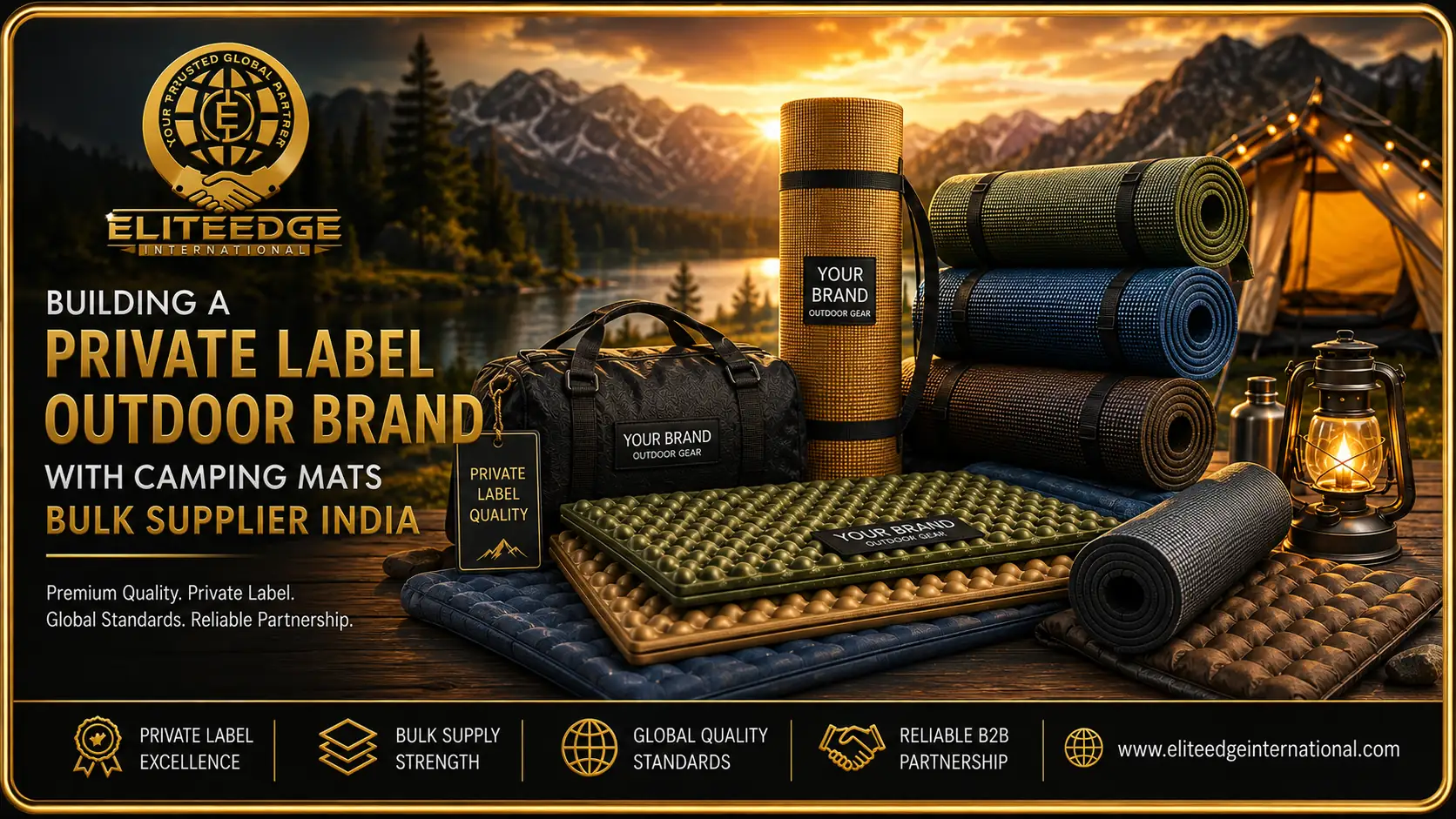
Private Label and OEM Opportunities
Private labeling can turn a generic product into a branded retail opportunity. An importer might purchase a standard construction but add its own colors, logo, labels, packaging, and marketing identity. Alternatively, an established brand may work with an exporter to develop a completely customized product.
Current Indian outdoor-mat manufacturers advertise OEM and private-label services including custom designs, branded packaging, barcode-ready labeling, and bulk production. Buyers should clarify minimum order quantities, development charges, sample procedures, packaging requirements, artwork specifications, and production lead times before entering a private-label agreement.
Quality Control for Export-Grade Picnic Mats
Quality control is where a reliable waterproof picnic mats exporter separates itself from an ordinary supplier. When an importer receives thousands of pieces, even a small manufacturing defect can become a serious commercial problem. Inconsistent dimensions, loose weaving, uneven borders, color variation, poor folding, or damaged packaging can affect customer satisfaction and increase returns.
A strong quality-control process should examine raw materials, production, finishing, dimensions, appearance, packaging, and final shipment. Buyers can also establish agreed tolerances before production begins. This gives both parties a measurable standard rather than relying on subjective expectations.
For large international orders, quality consistency becomes particularly important because repeat shipments need to match previous batches closely. A long-term supplier relationship works best when the exporter maintains documented specifications and follows a repeatable production process.
Waterproof Picnic Mats and Sustainable Outdoor Living
Sustainability has become an increasingly important consideration in outdoor products, but responsible communication matters. A product should not be described as "eco-friendly" simply because it is reusable or made from plastic. Buyers should understand the actual material composition, recycled content if applicable, manufacturing practices, packaging, durability, and end-of-life considerations before making environmental claims.
Some Indian outdoor mat manufacturers use virgin and recycled plastic in woven mat products and promote durable, reusable construction. Reusability itself can be commercially valuable because consumers often prefer products that can be cleaned and used repeatedly rather than discarded after one event. For brands developing sustainability-focused collections, the best approach is to communicate specific, verifiable attributes instead of vague green language.
Comparing Waterproof Picnic Mats With Traditional Mats
|
Feature |
Waterproof Picnic Mats |
Traditional Fabric Mats |
|
Moisture resistance |
Generally designed for outdoor moisture resistance |
Depends heavily on fabric and finish |
|
Outdoor suitability |
High for appropriate constructions |
Varies by material |
|
Portability |
Often lightweight and foldable |
Depends on fabric thickness |
|
Cleaning |
Often easy to wipe or wash |
May require more careful cleaning |
|
Design options |
Wide range of woven patterns |
Wide range depending on textile |
|
UV resistance |
Can be engineered for outdoor use |
Depends on fiber and treatment |
|
Custom branding |
Commonly available for bulk production |
Available but supplier dependent |
|
Best applications |
Picnics, beaches, camping, gardens, events |
Indoor and selected outdoor uses |
The comparison shows why outdoor-specific construction can be valuable. A traditional textile mat may be comfortable and attractive, but an outdoor product needs to account for moisture, dirt, sunlight, portability, and repeated cleaning. That does not mean one category is universally better. Instead, the correct choice depends on the intended environment and customer expectations.
How to Choose the Right Waterproof Picnic Mat
Choosing a supplier should begin with the end customer. If the target market is families, larger dimensions and comfortable construction may matter most. If the market is campers, portability and durability may take priority. If the product is intended for premium retail, patterns, packaging, and private labeling may be the deciding factors.
A buyer should evaluate material, weave, size, weight, folding method, edging, colors, UV performance, moisture resistance, cleaning requirements, packaging, customization, minimum order quantity, production capacity, and export experience. Samples should ideally be tested under realistic conditions before a major purchase is placed.
Price should be considered, but it should not become the only selection criterion. A lower factory price can quickly become expensive if quality problems, inconsistent colors, damaged packaging, delays, or poor communication create downstream costs.
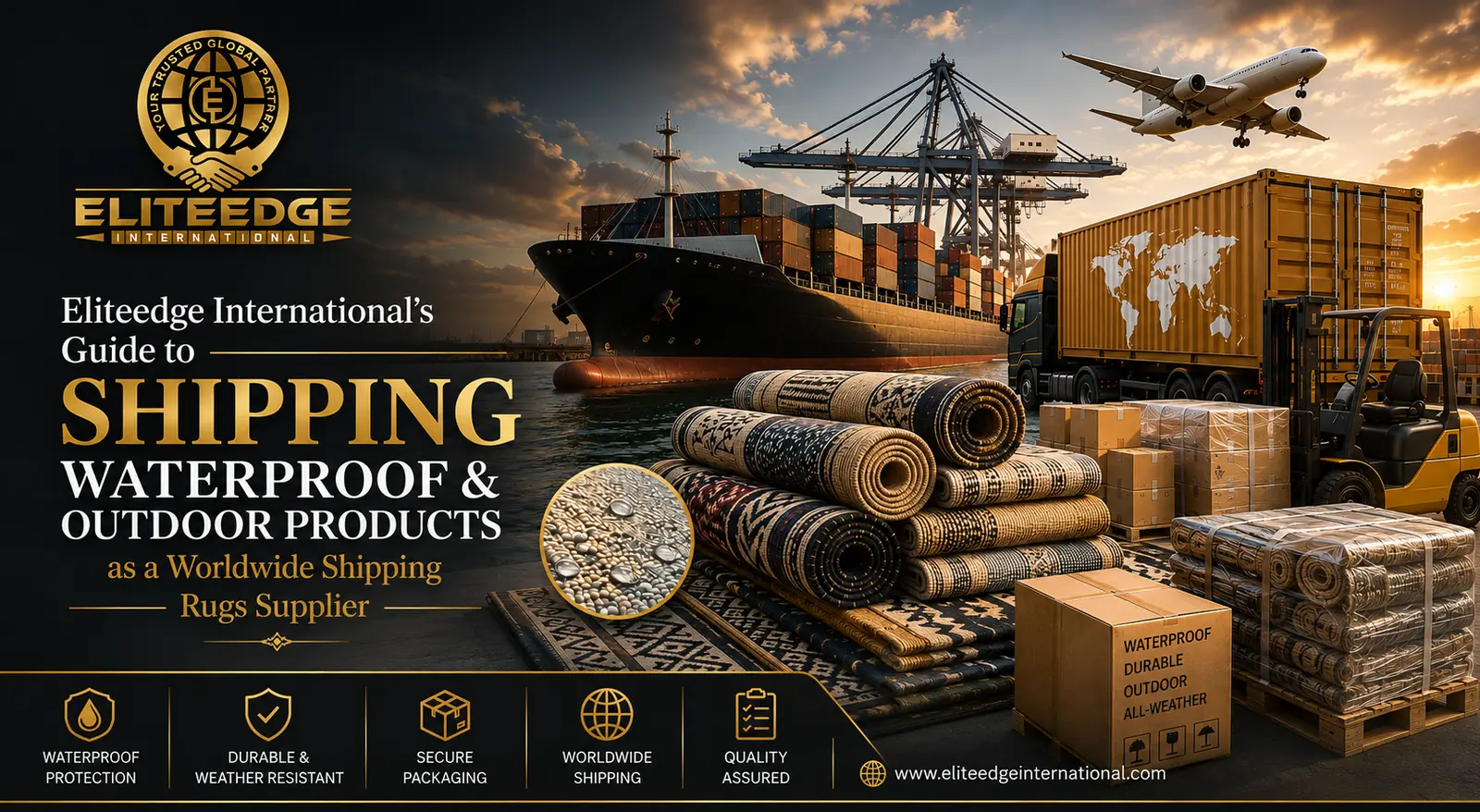
Packaging and International Shipping Considerations
A good product can still arrive in poor condition if packaging is inadequate. Outdoor mats should be packed according to their construction, folding method, destination, handling requirements, and buyer specifications. Export packaging may include individual polybags, branded packaging, cartons, labels, barcode stickers, and palletization depending on the customer's needs.
Shipping efficiency also matters because mats can occupy significant volume even when they are lightweight. Foldable or rollable construction can help optimize storage and transportation. Exporters should coordinate packaging dimensions with logistics requirements so that buyers understand how many pieces fit into cartons and how the shipment will be arranged.
International suppliers also need to manage export documentation and coordination with logistics partners. Established Indian mat exporters describe end-to-end export support involving documentation, packaging, and global logistics coordination.
Why Buyers Work With a Waterproof Picnic Mats Exporter
Working directly with an exporter can simplify sourcing because the buyer has one primary partner responsible for manufacturing and international shipment coordination. This can be especially useful for distributors and retail brands that require repeat orders.
A capable exporter can also provide product development support. Instead of simply sending a price list, the supplier can discuss suitable materials, sizes, designs, packaging, and target-market requirements. Over time, this creates a partnership rather than a transactional relationship.
For buyers sourcing from India, the broader export ecosystem provides another advantage. India's government reported total textile and apparel exports including handicrafts of ₹3,25,339 crore in 2025–26, while carpet exports reached ₹12,887 crore. The country's established floor-covering and textile manufacturing base can therefore provide useful infrastructure for international buyers looking for adjacent outdoor mat categories.
India’s Growing Textile and Floor-Covering Export Industry
India has a long-established reputation in carpets, rugs, textiles, and floor coverings. Government data released in March 2026 shows India's carpet exports reached US1.541billioninFY2024–25,comparedwithUS1.395 billion in FY2023–24. More recent industry data indicates India's carpet exports remained substantial in FY2025–26, with the United States continuing to represent a major destination.
That ecosystem matters because outdoor mats share several commercial fundamentals with other floor-covering products: weaving expertise, pattern development, color management, finishing, packaging, quality control, and export logistics. Buyers looking for a waterproof picnic mats exporter can therefore benefit from evaluating suppliers within India's broader floor-covering manufacturing network.
What International Buyers Should Ask an Exporter
Before placing an order, buyers should ask practical questions that reveal how prepared the supplier is for international business. What material is used? Is the product waterproof or water-resistant? What are the standard dimensions? Can the manufacturer customize sizes? Are private-label options available? What is the minimum order quantity? How are samples approved? What quality inspections are performed? What packaging options are available?
It is equally important to ask about production capacity and lead times. A supplier may be able to produce a small sample order but struggle with a large seasonal purchase. Buyers should therefore evaluate capacity against their expected volumes and sales calendar. This is particularly important for products connected to outdoor seasons, holidays, tourism, and promotional events.
Finally, request clear commercial terms. A professional supplier should be able to explain pricing structure, payment terms, production schedules, packaging costs, shipping arrangements, and required documentation. Transparency at the beginning usually prevents much larger problems later.
The Future of Waterproof Picnic Mats
The future of waterproof picnic mats is likely to be shaped by the same forces influencing many outdoor-lifestyle products: portability, durability, design, multifunctionality, and more responsible material choices. Consumers do not simply want equipment that works; they increasingly expect products to look good enough for social settings while remaining practical enough for repeated outdoor use.
For exporters, this means product development will become increasingly important. Reversible designs, coordinated collections, custom patterns, private labeling, compact packaging, and specialized outdoor applications can help suppliers move beyond commodity pricing. Indian manufacturers are already demonstrating capabilities in customized PP mats, including different designs, colors, sizes, and shapes.
The strongest suppliers will be those that combine manufacturing reliability with creative product development. For an international buyer, that combination can turn a simple outdoor mat into a scalable product range. In other words, the future is not just about making a mat that keeps moisture away. It is about creating a product that customers want to carry, use, reuse, and recommend.
Conclusion
A waterproof picnic mat may look like a simple outdoor accessory, but its commercial potential is much broader. The right product can combine moisture resistance, portability, easy maintenance, attractive design, durability, and versatility into one practical solution. That makes it suitable for picnics, beaches, camping, parks, gardens, festivals, outdoor events, and many other applications.
For international buyers, selecting the right waterproof picnic mats exporter requires careful attention to material quality, construction, customization, quality control, packaging, production capacity, and export experience. India offers a strong sourcing environment because its textile and floor-covering industries already have substantial international manufacturing and export capabilities. Government data confirms the continued scale of India's textile, handicraft, and carpet export sectors.
Ultimately, the best supplier is not necessarily the one offering the lowest quotation. It is the supplier capable of delivering consistent quality, practical product development, reliable communication, appropriate export packaging, and dependable repeat production. When those elements come together, waterproof picnic mats can become more than a seasonal product—they can become a valuable part of a growing outdoor-lifestyle collection.
FAQs
1. What are waterproof picnic mats used for?
Waterproof picnic mats are designed for outdoor activities such as picnics, camping, beach visits, parks, gardens, festivals, and outdoor gatherings. They create a more comfortable surface between users and the ground while helping reduce exposure to moisture and dirt.
2. Which material is commonly used for waterproof picnic mats?
Polypropylene (PP) is commonly used for outdoor picnic mats because it can provide a lightweight, durable, washable, and design-flexible construction. Some manufacturers also offer products incorporating recycled plastic.
3. Can I order customized picnic mats from an Indian exporter?
Yes. Indian manufacturers and exporters offer customization options such as sizes, colors, patterns, shapes, and private-label branding. Some suppliers also provide OEM programs and branded retail packaging.
4. What should I check before choosing a waterproof picnic mats exporter?
Check the supplier's material specifications, product construction, quality-control procedures, customization capabilities, minimum order quantity, production capacity, packaging, export experience, documentation, and delivery terms. Always request samples before committing to a large order.
5. Why source picnic mats from India?
India has a large and established textile and floor-covering manufacturing ecosystem with significant international export experience. Government data shows substantial exports across textiles, handicrafts, carpets, and man-made textile categories, providing international buyers with access to a broad manufacturing base.