
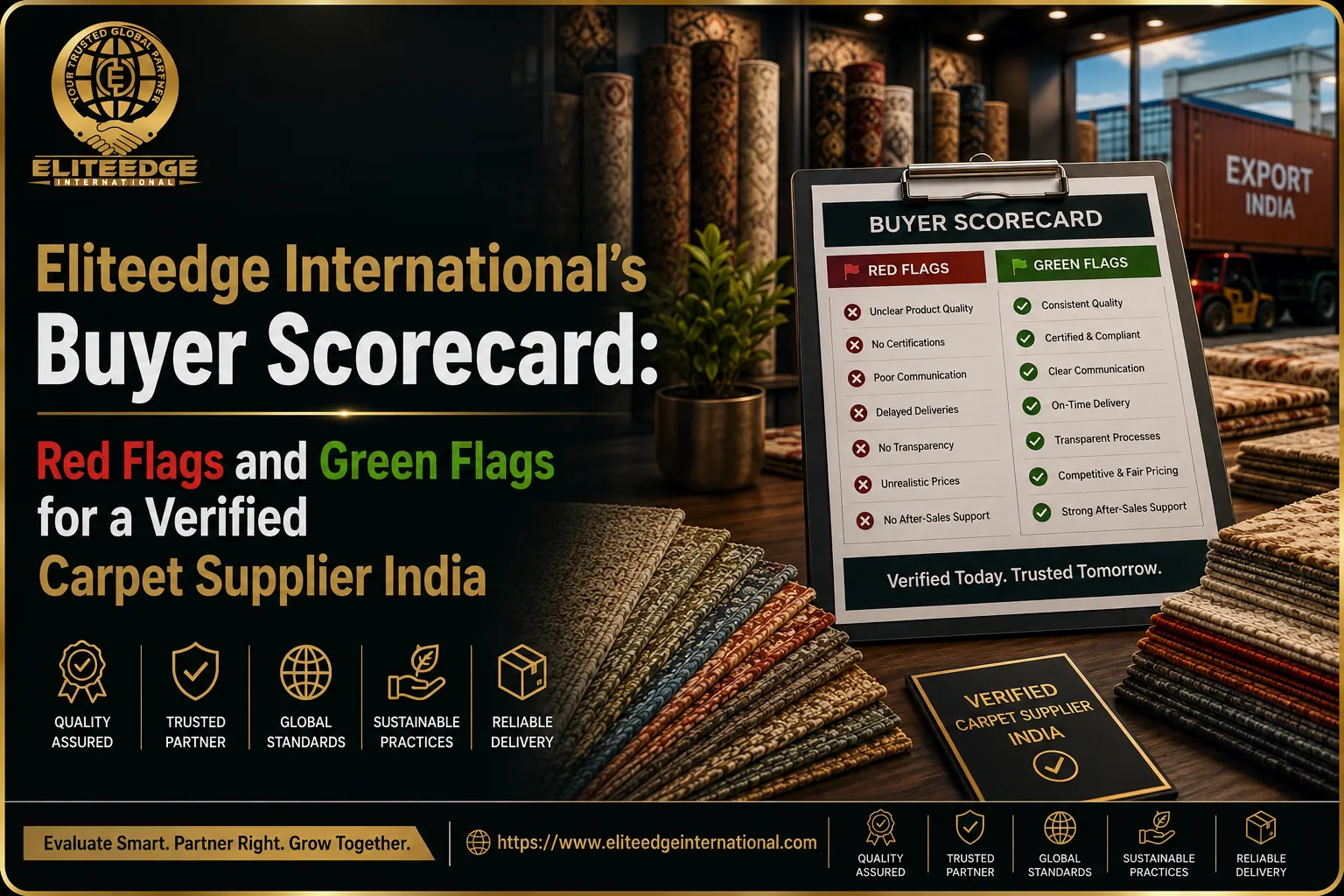
Checklists tell a buyer what questions to ask. A scorecard goes one step further, helping a buyer weigh the answers against each other once several suppliers have actually responded. After enough conversations with international buyers, certain patterns become obvious: some answers reliably predict a smooth, dependable relationship, while others reliably predict future frustration, regardless of how polished the initial sales pitch happened to be. This article organises those patterns into a practical scorecard buyers can use when comparing a verified carpet supplier India relationship against alternatives, helping translate a series of individual conversations into a clearer overall picture. Eliteedge International, based in Jalgaon, Maharashtra, encourages buyers to apply exactly this kind of structured comparison, since a supplier confident in its own operation has nothing to lose from being measured against clear, specific criteria.
The goal here is not to produce a rigid numeric score that removes all judgement from the decision, but to give buyers a consistent framework for noticing patterns across multiple supplier conversations, patterns that are easy to miss when each conversation is evaluated in isolation rather than compared systematically against the others.
Green Flags That Suggest Genuine Export Quality Capability
Specific Answers to Specific Questions
A supplier who responds to a detailed question about quality control, sizing consistency, or shipping timelines with an equally detailed, specific answer is demonstrating genuine operational knowledge rather than reciting marketing language. When evaluating export quality carpets India claims, specificity is one of the strongest positive signals available to a buyer, since vague answers can be produced by anyone, but specific, accurate operational detail generally only comes from someone who actually understands their own production process.
Willingness to Discuss Limitations Honestly
Paradoxically, a supplier willing to acknowledge a limitation, whether that involves current minimum order quantities, a specific colour that is harder to produce consistently, or a shipping route with a longer than average transit time, is often more trustworthy than one who claims no limitations exist at all. Genuine businesses have genuine constraints, and a willingness to discuss them openly suggests a supplier confident enough in their overall value to be honest about the parts of their offering that are not perfect.
Proactive Documentation Sharing
Suppliers who volunteer relevant documentation, such as GST registration details, production photographs, or references, before being explicitly asked demonstrate a level of transparency that goes beyond simply answering direct questions when pressed. This proactive sharing suggests a business accustomed to operating under scrutiny and comfortable with that scrutiny, rather than one hoping a buyer will not ask too many probing questions.
Consistent Communication Across Multiple Interactions
A supplier who communicates with the same level of detail, responsiveness, and professionalism across several separate conversations, rather than being highly attentive during an initial sales pitch and noticeably less engaged afterward, is signalling a more sustainable, genuine level of service quality rather than a front loaded sales effort designed primarily to close the first order.
Red Flags That Suggest Caution Is Warranted
Evasiveness Around Basic Business Verification
A supplier reluctant to confirm basic details such as their registered business address, tax registration, or the identity of the business owner should be treated with significant caution. Legitimate businesses generally have no reason to withhold this kind of standard verification information from a serious buyer conducting normal due diligence.
Pressure to Skip the Sampling Process
Any supplier actively discouraging a buyer from requesting samples before a bulk order, particularly for a first time relationship, warrants scrutiny. Legitimate suppliers generally understand and accept that sampling is a standard, expected part of the buying process, and resistance to this step should be treated as a meaningful warning sign rather than dismissed as an unimportant preference.
Inconsistent Pricing Across Similar Requests
If a supplier provides noticeably different pricing for very similar order specifications across separate conversations, without a clear explanation for the difference, this inconsistency can indicate either disorganised internal processes or an attempt to test how much a particular buyer might be willing to pay, neither of which suggests a reliable long term pricing relationship.
Reluctance to Put Terms in Writing
A supplier who prefers to keep pricing, specifications, or delivery timelines as verbal agreements rather than documenting them in writing should raise concern, since this reluctance removes the buyer’s protection if a disagreement later arises about what was originally promised.
Using the Scorecard in Practice
Scoring Multiple Suppliers Consistently
Buyers comparing several suppliers should apply the same specific questions and the same evaluation criteria across every conversation, resisting the temptation to ask a more thorough set of questions to a supplier they already feel positively about while going easier on one they are less enthusiastic about. Consistent application of the same scorecard across every candidate produces a far more reliable comparison than an inconsistent, instinct driven evaluation process that varies from one conversation to the next.
Weighing Green Flags Against Red Flags Honestly
No supplier will present a perfect scorecard with only green flags and zero red flags. Buyers should weigh the overall pattern honestly, recognising that a single minor red flag, clearly explained and reasonably addressed, may not disqualify an otherwise strong supplier, while a pattern of multiple red flags across several categories should be taken seriously regardless of how appealing the product samples themselves appear at first glance.
Revisiting the Scorecard as the Relationship Develops
The scorecard is not just a one time evaluation tool for the initial supplier selection decision. Buyers should continue applying similar criteria as an ongoing relationship develops, watching for any decline in communication quality, documentation practices, or consistency that might signal a supplier’s standards slipping over time, even after an initially strong evaluation during the first few orders.
Common Scoring Mistakes Buyers Should Avoid
Overweighting the First Impression
The very first response from a supplier, whether unusually warm and attentive or slightly slow and impersonal, tends to carry disproportionate weight in a buyer’s overall impression, simply because it arrives before any other information is available for comparison. Buyers should consciously guard against letting this first impression dominate the entire scorecard, instead treating it as one data point among several gathered across the full evaluation process, since a supplier having an unusually busy day during a first contact should not automatically be read as representative of their typical service standard.
Confusing Enthusiasm With Competence
A highly enthusiastic, fast talking sales representative can create a strong positive impression that does not necessarily correlate with the underlying operational competence of the business they represent. Buyers should separate their evaluation of communication style from their evaluation of substantive answers to specific operational questions, since genuine competence sometimes comes packaged in a more understated communication style, and genuine enthusiasm sometimes masks a lack of substantive depth once probing questions are actually asked.
Ignoring Red Flags Because of Attractive Pricing
An unusually low quoted price can make buyers reluctant to weigh red flags as heavily as they otherwise would, since the financial appeal creates pressure to overlook concerns that would otherwise prompt further scrutiny. Buyers should specifically guard against this tendency, since a price that seems too good relative to comparable quotations from other suppliers often reflects a genuine quality or reliability tradeoff rather than simply superior efficiency, and red flags accompanying an unusually attractive price deserve more scrutiny, not less.
Treating a Single Strong Order as Proof of Long Term Reliability
A single successful trial order, however smoothly it went, represents a limited sample size from which to draw firm conclusions about long term reliability. Buyers should continue applying scorecard style scrutiny across subsequent orders rather than assuming that one positive experience has definitively answered every question raised during the initial evaluation, since genuine long term reliability can only really be demonstrated through a track record built over multiple transactions across different conditions and circumstances.
How This Scorecard Complements Rather Than Replaces Direct Conversation
A scorecard framework works best as a structured lens applied during genuine, substantive conversation with a prospective supplier, not as a replacement for that conversation itself. Buyers should resist the temptation to treat this as a purely mechanical checklist exercise disconnected from actually listening carefully to how a supplier communicates, what they emphasise unprompted, and how they respond when a conversation moves beyond the most predictable, commonly asked questions into more specific or unusual territory relevant to a buyer’s particular situation.
The most valuable insights often emerge not from the specific answer to a scripted question but from how a supplier handles an unexpected follow up question or a scenario they had not necessarily anticipated being asked about. Buyers who combine this structured scorecard approach with genuine, attentive conversation tend to develop a more complete and more accurate picture of a prospective supplier than those relying on either approach in isolation.
Applying This Framework to Eliteedge International
Buyers can apply this exact scorecard directly to their conversations with the verified carpet supplier India team at Eliteedge International, evaluating the company’s responses against the same green flag and red flag criteria used for any other prospective supplier under consideration. This kind of structured, even handed evaluation is precisely what a genuinely export quality carpets India business should welcome rather than avoid.
Buyers ready to begin this evaluation process can reach out to Eliteedge International with their specific product requirements and apply this scorecard framework directly to the resulting conversation.
Building Your Own Weighted Version of This Scorecard
While the green and red flags outlined above apply broadly across most sourcing situations, individual buyers may reasonably weigh certain criteria more heavily depending on their specific business priorities. A buyer planning a single modest trial order might weigh communication responsiveness more heavily than long term pricing consistency, while a buyer planning a multi year private label partnership might place much greater weight on documentation practices and consistent quality control, since the financial exposure and relationship duration involved differ substantially between these two scenarios.
Building a simple written version of this weighted scorecard before beginning supplier conversations, even something as basic as a short list of the criteria that matter most for a specific sourcing decision, helps buyers stay disciplined and objective as they move through what can otherwise become an emotionally persuasive series of sales conversations. It is easy to be swayed by an especially charming or attentive sales representative in the moment, and a written scorecard prepared in advance provides a useful anchor back to the criteria that actually matter for the buyer’s specific situation once the initial impression has faded and a more considered decision needs to be made.
Conclusion
A structured scorecard, weighing specific green flags against specific red flags, gives buyers a far more reliable way to compare multiple suppliers than relying on instinct or an isolated impression from a single conversation. Genuine specificity, honesty about limitations, proactive documentation sharing, and consistent communication all suggest a dependable verified carpet supplier India relationship, while evasiveness, pressure to skip sampling, inconsistent pricing, and reluctance to document terms in writing all warrant real caution before committing to a significant order.
If your business is comparing suppliers and wants a partner willing to be evaluated against clear, specific criteria, reach out to Eliteedge International to discuss your requirements directly.
Frequently Asked Questions
1. How many red flags should disqualify a supplier from consideration?
There is no fixed universal number, since context matters considerably. A single, clearly explained minor red flag may not disqualify an otherwise strong supplier, while a consistent pattern across multiple categories, such as evasiveness combined with pricing inconsistency, should generally be treated as a serious concern regardless of how appealing the product itself appears.
2. Is it reasonable to apply different scoring standards to a new versus an established supplier?
Buyers can reasonably apply somewhat different expectations to a newer business without an extensive track record, but basic business verification and communication quality standards should remain consistent regardless of how long a supplier has been operating, since these fundamentals are achievable at any stage of a business.
3. What should buyers do if a strong supplier has one significant red flag?
Buyers should raise the specific concern directly with the supplier and evaluate how they respond. A supplier who addresses the concern thoughtfully and transparently may still be worth pursuing, while one who becomes defensive or evasive when the concern is raised directly provides additional useful information for the overall evaluation.
4. How often should buyers reapply this scorecard to an existing supplier relationship?
Periodically revisiting the scorecard, perhaps once or twice a year or after any significant issue arises, helps buyers notice gradual changes in a supplier’s standards that might not be obvious from any single interaction viewed in isolation.
5. Can this scorecard be adapted for evaluating suppliers outside the carpet and mat industry?
Yes, the underlying principles around specificity, honesty, documentation, and consistency apply broadly across many types of international sourcing relationships, not just carpet and mat exporters specifically.
6. What is the single most reliable green flag according to this framework?
Specificity in answers to detailed questions tends to be one of the most reliable positive indicators, since it is difficult to fake convincingly and generally reflects genuine operational knowledge rather than rehearsed marketing language.
7. Should buyers share their scorecard criteria with suppliers directly?
Some buyers find it useful to be transparent about their evaluation criteria, since this signals seriousness and gives a supplier the opportunity to address any concerns proactively, while other buyers prefer to keep their internal evaluation process private to observe more natural, unprompted responses.
8. Does a strong scorecard result guarantee a problem free relationship?
No evaluation framework can guarantee a completely problem free relationship, since unexpected issues can arise even with genuinely strong suppliers. The scorecard significantly improves the odds of a positive relationship by filtering out clearly weaker candidates, but ongoing communication remains important throughout the relationship regardless of how strong the initial evaluation appeared.